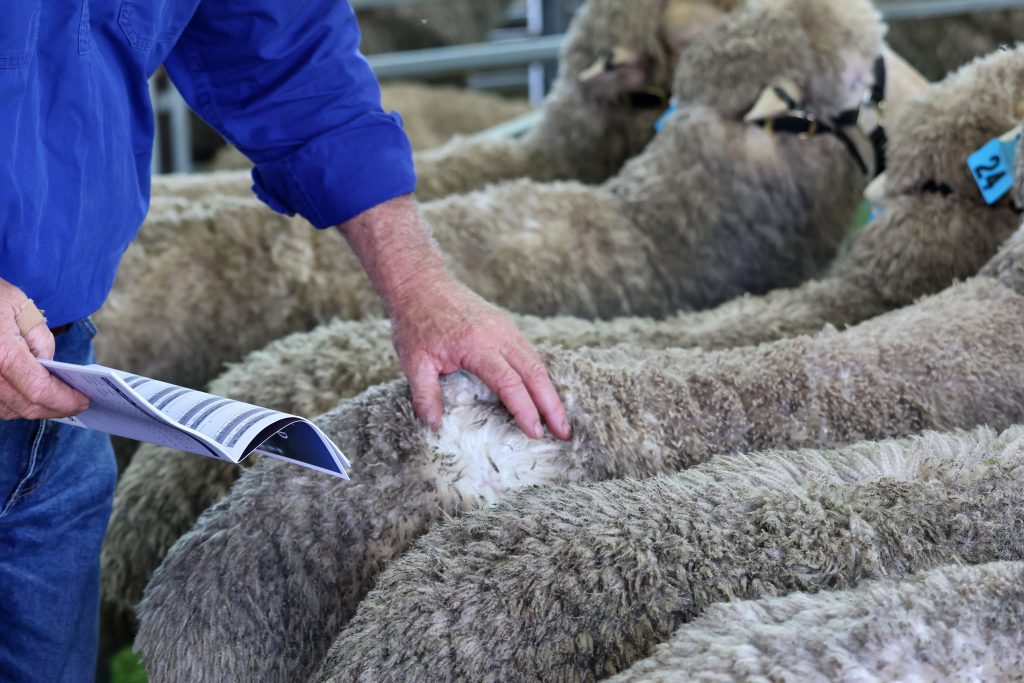
The new SRS index aims to help SRS Merino breeders balance production, resilience and carcase trait goals.
SRS Merino breeders now have a new selection index balancing production, resilience and carcase trait goals with economic weightings for 22 traits.
The new selection index has been developed by SRS Genetics to equip stud and commercial sheep producers to break the complexity of Australian Sheep Breeding Values (ASBVs) into clear production outcomes.
The SRS (Soft Rolling Skins™) selection index was developed in collaboration with New Zealand sheep geneticist, Dr Mark Ferguson, neXtgen Agri, with the aim to highlight the animals carrying a balance of production, quality and resilience traits representing the SRS breeding objective.
SRS Genetics chairman Norm Smith said the customised breeding value gave economic weightings to a combined 22 traits.
“There are Merino industry indexes available, but this is more specific around what SRS breeders are wanting to achieve in increased production, resilience and carcase quality,” he said.
“We consulted widely with SRS stud breeders before introducing the index and it will be available for the studs to use this selling season.
“This is SRS Genetics’ first customised index – visual indicators for density and length remain important but this is another selection tool for stud breeders and our commercial clients to simplify ram selection.”
Mr Smith said with producers having different goals, environments and markets, the index gave them one clear focus of commercial profitability.
“SRS breeders strongly advocate the visual selection for density and length based on the late Dr Jim Watts’ breeding philosophy and a physical assessment of structure and shape.
“The SRS Index is another tool to help breeders achieve their goal of a highly profitable, ethical and resilient breeding flock.”
NSW SRS breeder Tom Hooke, East Loddon Merinos at Wanganella, said a key point of difference for the SRS Merino was a superior wool quality on a wrinkle-free skin, minimising the instances of fleece rot and flystrike.
This is represented with the inclusion of traits such as CV (coefficient of variation), staple strength, colour, curvature, strength, length and micron.
“Doing ability is likely the best term to describe a ewe’s ability to remain reproductively fit when challenged and produce fast growing and earlier finishing lambs,” Mr Hooke said.
“This is represented with the inclusion of growth, fat and muscle, as well as WEC (worm egg count) and weaning rate in the index.”
IMF (Intramuscular Fat) for eating quality, has also been included to ensure producers are selecting for animals that will again drive production, whilst maintaining a quality product into the future.
“True performance is when an animal can offer real production even when under varying environmental challenges. The SRS index captures many important traits in a balanced way for easier selection,” Mr Hooke said.
For decades, SRS Genetics has been built on scientific evidence, practical observations and continuous improvement. By combining research with on-farm results, producers can use the index to make informed breeding decisions for the future.
Dr Mark Ferguson said traits SRS breeders wanted to stabilise or improve, including muscle, fat, reproduction, fleece weight, micron, dags and worm egg count, were weighted within the index.
“This index is designed to build on the inherent strengths of the SRS sheep but also picks up on any traits needing improvement,” Dr Ferguson said.
“For commercial producers the index will deliver the profitable outcome they are after based on the combination of traits SRS breeders agree will make money.”
Dr Ferguson said the index was available in time for ram breeders to make their selection decisions on ewes and sale rams, or inclusion in their sale catalogues.
“Obviously individual breeders have slight selection nuances around their sheep but as a group the index is taking them that next step further,” he said.
“For a producer buying a single ram or semen, they may want to look into every trait, but if they are buying a team of rams, selecting on the average index would be a good drafting gate. That applies equally to ewe selection.”
The positive economic weightings are for yearling and adult clean fleece weight, yearling staple length, post weaning weight, fat, eye muscle and fat depth. The positive reproductive traits are condition score, ewe rearing ability, weaning rate and litter size.
The negative weightings are for yearling coefficient of variation of fibre diameter, yearling fibre and adult fibre diameter, yearling curvature, adult weight, breech coverage and wrinkle, fleece rot, dags and worm egg count.
South Australian breeder Stephen Kellock, Kelvale Poll Merinos, Keith, transitioned to an SRS system to lower micron, improve handle and move to a softer, better type of wool.
Kelvale is among the country’s top flocks for staple length and selection has focused on positive fat, muscle and survivability.
Mr Kellock felt other industry indexes were too general for his breeding objectives, and he would use the SRS selection index to aid in ram and ewe selection, and increase genetic gain within his flock.
“As a breeder, I’m finding this index is more correlated with our focus of improving fertility, welfare and production parameters,” he said.
“Fertility, including the number of lambs on the ground, is a big driver within the SRS sheep. As a group we are always looking to improve the wool traits and, in the long run, the index will verify that we are going in the right direction.”
Mr Kellock said commercial producers could benefit from the index’s weightings on fertility including number of lambs weaned and ewe rearing ability.
“The SRS as a collective is providing breeders with the tools to push ahead for the good of the whole sheep industry.”
HAVE YOUR SAY