
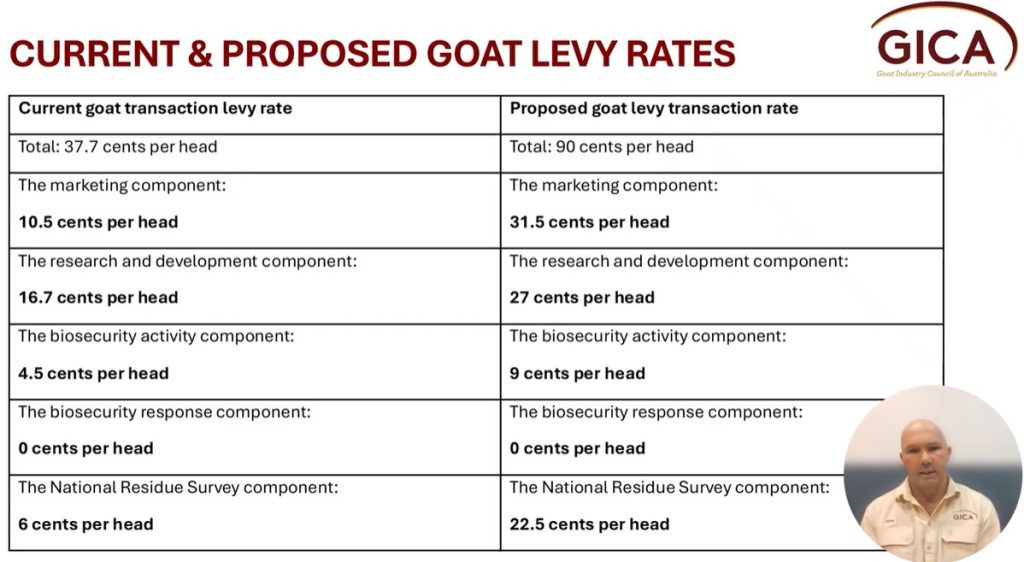
GOAT producers will this week hear feedback gathered in an Australia-wide consultation on lifting the sector’s transaction levy from 37.7 cents to 90 cents.
The Goat Industry Council of Australia said feedback gained from the extensive series of workshops for goat producers will form part of a proposition that could see the biggest change to its levy structure in nearly 30 years.
Council members have been touring Australia, informing goat producers and other industry participants of the GICA proposal to change the levy to allow increased investment, seen as essential for the long-term growth of the sector.
The next step in the engagement process will be an August 20 webinar where all stakeholders will hear feedback from the meetings and an update on the process. Members can register for the webinar here.
Mr Falkenhagen said very few people have disagreed on the need for an increase in the levy, but there has been healthy discussion on which of our service providers should benefit from that increase and by how much.
The current and proposed levy apportionment is as follows:
- Meat and Livestock Australia (MLA) marketing: 10.5 cents to 31.5 cents per head
- MLA research and development: 16.7 cents to 27 (matched with Australian Federal Government funds)
- Animal Health Australia (AHA): 4.5 cents to 9
- National Residue Survey (NRS): 6 cents to 22.5
Mr Falkenhagen said the feedback was supporting the proposed levy apportionment and producers were not proposing to oppose the levy rise unless it changed.
“Because they’ve listened, we’ve had the discussion, they’ve said ‘we get it and we understand why that has to go up and you’ve heard us that we want a marketing increase’, which is what we’ve done.”
Mr Falkenhagen said the suggested increase is essential to the future of the industry and in the best interests of all who are connected with goat production.
“Our levy has not changed since 1997, but the industry has changed a lot in those years. We need to invest more in our industry for future strength and growth, and increased investment would mean more money for research and development, marketing, biosecurity and animal health.”
Any proposal to government for a levy change must include significant sector engagement and consultation. GICA leaders delivered consultation workshop in Tasmania, Western Australia, Victoria, New South Wales, Queensland and South Australia.
“These meetings have been very useful in understanding all the feedback, issues and opinions from our levy-paying members and I am pleased to say the meetings have been supportive and positive.
Mr Falkenhagen said while is happy with the conversations at each event he would have liked to have seen more people attend, and that’s why it’s important that every producer has their chance to vote at MLA’s AGM on November 24 this year.
“We have had good support at every meeting but if people don’t turn up to vote then the proposal won’t pass.
“The MLA voting packs will be on their way to producers soon and I encourage everyone to make sure they have their say, whether that’s in person, online or by proxy.”
Source: GICA.
I find it rather coincidental that GICA has raised this issue at the same time that the goat meat industry is somewhat buoyant; most likely spurred on by a money hungry MLA. Anyone in favor of this ridiculous idea must have a very short memory; It wasn’t that far back that goats where worth $8-$10/kg on the hook and within a very short time had crashed to under $3/kg and took a long time to come back up.
And this suggested (levy) increase comes at a time when primary producers are copping it in all other directions, such as the costs of all our operational input needs — fuel, fencing equipment, rates etc, etc, etc. Do I need to go on?
A question for GICA/MLA :- If the industry agrees to the raise in levy and then the goat meat prices crash again, will you reduce the levy back to it’s current amount?
I doubt that anyone will get up and answer that question.
I call on all goat producers to reject this preposterous idea and put GICA/MLA back in their place.