
MAJOR North American veal and lamb packer Catelli Brothers has confirmed its support for Australia’s Protect Lamb Supply initiative to inform the United States International Trade Commission’s global safeguard investigation into imported lamb.
The U.S. International Trade Commission last month initiated a global safeguard investigation on fresh, chilled, and frozen lamb meat following a request from the U.S. Trade Representative, who was petitioned by the American Sheep Industry Association seeking relief from lamb imports and potentially higher tariffs than the current 12.5 percent.
The PLS initiative is being funded by Australian Meat Industry Council, Meat & Livestock Australia and Sheep Producers Australia, independent of the Australian Government. It also has the backing of major Australian lamb exporters Thomas Foods International and Fletcher International Exports.
Thomas Foods International’s chief commercial officer Jonathon Bayes said the United States is a key market for the Australian meat industry and Thomas Foods International.
“As Australia’s largest smallstock processor and a major lamb exporter to the US, we are supportive of, and actively involved in, this initiative which we view as being pursued in the best interests of the industry, farmers and consumers across both countries.”
The PLS initiative involved the establishment of a website on 1 August by AMIC that urges offshore and domestic players in the North American lamb supply chain to make submissions to the USITC investigation this month, highlighting the value of imported lamb to their businesses and the impact of potential supply restrictions.
The PLS website’s home page describes itself as: “A plain-language guide for American lamb businesses on the Section 201 safeguard case — and how to keep your supply steady, serve your customers, and protect jobs.”
Reliable lamb supplies support US factories, farms and families
Catelli Bros is the US meat division of Préval AG, a Canadian-based international agri-food company with over 50 subsidiaries in the US and Canada. Along with the Canadian Meat Division, Montpak International, it makes up part of the largest veal and lamb company in North America.
Catelli Brothers president and chief executive officer Anthony Catelli said the company is proud to lend its voice to Protect Lamb Supply, “because a reliable supply of lamb supports American factories, farms and families.”
“The entire lamb industry, including thousands of businesses and tens of thousands of jobs, depend on a reliable supply of all sorts of lamb year round.
“Our 80 year old company exists because we’ve always given the customer what they want,” he said.
“In the case of lamb, this means a consistent supply of a variety of lamb options with different flavor profiles, sizes and attributes.
“We do this by offering both domestic and imported lamb,” Mr Catelli said.
“Our company processes American lamb, Australian lamb and New Zealand lamb, and markets all three varieties to the retail and food service sectors nationwide.
“We are passionate about selling all three varieties because each has a different application, just as beef has different varieties such as Prime, Organic, Grass-Fed, Wagyu etc,” he said.
“We view the three varieties of lamb as distinct offerings, and it is only by offering all three that we can meet the rising demand for lamb in the US.
“Any restriction on imported lamb would mean a higher cost to the consumer and damage the sales of the lamb category as a whole in the US,” Mr Catelli said.
“It would lead to less lamb consumption overall because it would be harder to source, more expensive and less competitive than other proteins.”
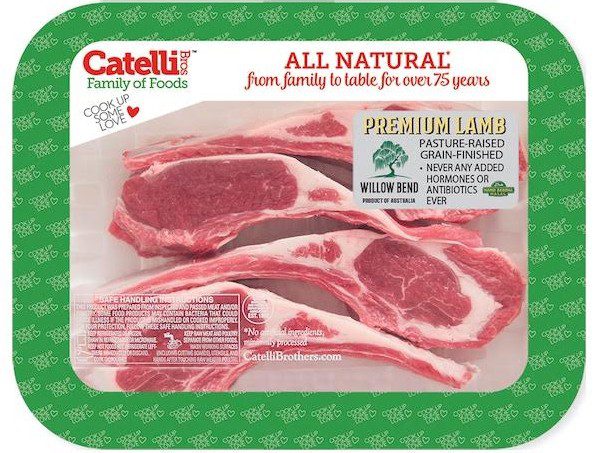
Catelli Brothers’ Australian lamb offering includes free-range, grass-fed standard Australian lamb, and New South Wales lamb and seedstock producer Tom Bull’s high eating quality Willow Bend Premium Australian Lamb brand supplied via Endeavour Meats in Orange, New South Wales, and sourced from flocks utilising Primeline genetics.
Mr Bull said the high intramuscular fat (average 5.5-5.7 pc year-round) Willow Bend brand was launched five years ago and is being placed into high-end retailers and foodservice by Catelli Brothers.
“Willow Bend has been a fantastic market for Primeline maternal clients sending their lambs straight into the USA’s highest value market.
“This lamb has been sold side-by-side, not instead of, American lamb,” he said.
“We’ve worked for years to get lamb into these top American retailers and foodservice, and it’s working really well.
“There isn’t such a thing as a regular supply of lamb in the US, so companies need to have Australian lamb to basically smooth the (supply) shoulders out,” Mr Bull said.
“Probably the strength of Willow Bend was in 2023 when the lamb price crashed and Willow Bend didn’t change; it was a really valuable lesson in the value of having an end-to-end supply chain.”
ITC submissions encouraged on role of imported lamb
The Protect Lamb Supply funders have refused to discuss their ongoing strategy, including at a proposed USITC public hearing on 16 October. However, AMIC chief executive officer Tim Ryan said the council established the Protect Lamb Supply website, in collaboration with industry partners, to communicate the complementary role of domestic and imported lamb in the US market and to engage key stakeholders and US end-users of lamb throughout the s201 investigation.
“Importantly, imported lamb complements domestic production, helping keep lamb on shelves and menus year-round.
“Thousands of American businesses and tens of thousands of American jobs depend on a reliable supply of lamb being available year-round,” he said.
“AMIC respects the ITC’s process and will engage constructively and in good faith to put our case forward.
“AMIC is encouraging our exporter membership and US buyers of lamb to provide responses to the ITC questionnaire to ensure the investigation has the necessary data to understand the role of imported and domestic lamb in the US market,” Mr Ryan.
The USITC investigation is tasked with determining whether an article, in this case lamb, is being imported in such increased quantities as to be a substantial cause of serious injury or the threat of serious injury to a U.S. industry. However, as indicated by Mr Catelli, Sheep Central believes Australia and the PLS partners are hoping to highlight how restricting imports might damage US businesses, consumer choice and ongoing US and imported lamb demand.
The ITC has also said global safeguard investigations do not require a finding of an unfair trade practice such as under the U.S. countervailing duty law (a foreign subsidy) or the antidumping duty law, indicating the US market impact of imported lamb pricing compared to that of US lamb products is outside the investigation’s terms of reference.
Australian Government putting ‘the strongest possible case’
A spokesperson for Australia’s Minister for Trade and Tourism Don Farrell said the Albanese Government is working closely with industry to put forward the strongest possible case for why Australian lamb exports should continue unimpeded.
“Minister Farrell has also raised this directly with his counterpart, US Trade Representative Greer on several occasions including during their most recent engagement.”
Sheep Central has been told the Australian Government is fully engaging in the safeguard investigation process to defend Australia’s interests; including making written submissions, providing evidence, and participating in the upcoming USITC public injury hearings on 16 October 2026. Separate to the formal investigation, the Australian Government is also engaging across the US system to express the country’s concerns regarding a potential safeguard measure.
Minister Farrell has raised this issue directly with USTR Jamieson Greer in February, June, and again on 11 August 2026. The Australian Government submitted a formal submission seeking to participate as an official party in the US International Trade Commission’s Section 201 investigation on 27 July 2026.
MLA confirmed its support for the Protect Lamb Supply initiative, but MLA managing director Michael Crowley was unavailable for comment. TFI did not respond to questions from Sheep Central.
The USITC has scheduled an in-person public hearing and webinar on the serious injury lamb meat inquiry for October 16, 2026, in Washington, D.C., from 9:30 am EDT. This puts the hearing starting at 12.30am Australian Eastern Daylight Saving Time on 17 October for south-east Australian watchers. Individuals interested in observing the hearings can join the WebEx webinar via the information below.
Join from the webinar link
https://usitc.webex.com/usitc/j.php?MTID=me539a5a3f94d82035c79cd9cf9fedd97
Join by the webinar number
Webinar number (access code): 2819 286 8775
Webinar password: d5XDcTe4pe4 (35932834 when dialing from a phone or video system)
Tap to join from a mobile device (attendees only)
+1-415-527-5035,,28192868775#35932834# US Toll
Some mobile devices may ask attendees to enter a numeric password.
Join by phone
+1-415-527-5035 US Toll
Global call-in numbers
For more information click on this notice link: Institution of Investigation, Scheduling of Public Hearings, and Determination that the Investigation is Extraordinarily Complicated
The USITC will make its serious injury determination by 13 November 2026. If the commission makes an affirmative serious injury determination or is equally divided on the question of injury in the investigation, it will hold a hearing on the question of remedy on December 1, 2026.
The USITC will submit a report to US president Trump as required under section 202(f) of the Trade Act of 1974 within 180 days after the date of the USTR request, or by January 11, 2027. The imported articles covered by the investigation are defined as fresh, chilled, or frozen lamb meat. Live animals and mutton are excluded from the investigation.
HAVE YOUR SAY