
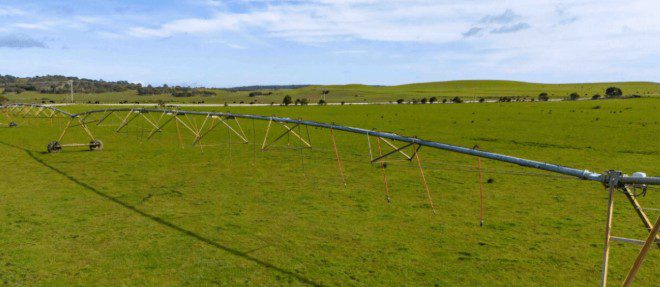
Irrigated pasture at Rushy Lagoon.
The Tasmanian Government today released the terms of reference for a Parliamentary Select Committee inquiry into the sale of the state’s biggest farm, Rushy Lagoon, to the United Kingdom-based Tasmania Natural Asset Trust.
The state government believes the Federal Labor Government used almost $70 million of taxpayer dollars to bankroll the sale of Rushy Lagoon to the trust, which plans to plant 9000 hectares of pine trees on the property.
Despite pressure to block the foreign acquisition of the farm for conversion into a major tree plantation generating timber and carbon credits, Federal Treasurer Jim Chalmers and the Foreign Investment Review Board have approved the sale.
However, Liberal Senator for Tasmania Richard Colbeck has established that the trust is 49 percent owned by the Commonwealth via a $69 million equity investment from the Clean Energy Finance Corporation. He has asked the Australian National Audit Office to examine the Albanese Government’s ‘Support Plantation Establishment’ grant of $8.8 million to the trust counter to grant guidelines and before the land sale had been approved by the FIRB.
Premier Jeremy Rockliff said the proposed Select Committee will inquire into the influence of the Commonwealth on the sale of productive agriculture land in Tasmania for carbon sequestration.
“Rushy Lagoon has long been recognised as one of Tasmania’s premier agricultural enterprises, supporting jobs, regional economic activity and food production.
“Our government is a strong supporter of the forestry industry; however, Tasmanians want and deserve answers over the Federal Government’s involvement in the sale and what it means for productive agricultural land across our State,” he said.
“It’s high time Tasmanian Labor stood up for Tasmanians instead of caving to Canberra over the sale of Rushy Lagoon.”
The proposed terms of reference include:
- The influence of Commonwealth funding, financing and policy mechanisms, including the Clean Energy Finance Corporation (CEFC), the Australian Carbon Credit Unit (ACCU) Scheme, the Support Plantation Establishment Program and other Commonwealth initiatives, on the acquisition, ownership and use of strategically significant agricultural land in Tasmania, including the acquisition of Rushy Lagoon and associated properties;
- The extent to which Commonwealth programs and incentives have facilitated the conversion of productive agricultural land in Tasmania to carbon sequestration, plantation forestry or biodiversity-related land uses, and the impacts of those changes on agricultural production, food and fibre industries, employment, regional communities and opportunities for agricultural ownership;
- The consideration given by the Foreign Investment Review Board and other Commonwealth decision-makers to Tasmania’s agricultural, economic and regional interests in relation to the acquisition of Rushy Lagoon and associated properties;
- The adequacy of Commonwealth assessment, consultation, approval and oversight processes relating to decisions affecting strategically significant agricultural land in Tasmania; and
- Legislative, regulatory, administrative or policy reforms to improve transparency, accountability and consideration of Tasmania’s interests in Commonwealth decisions affecting strategically significant agricultural land.
TasFarmers backs inquiry
TasFarmers president Nathan Cox said the process was clearly inappropriate, advantaged a foreign-backed buyer over Australian agricultural interests and failed to give sufficient weight to food security.
“An inquiry is needed to ensure this can never happen again.
“There are better ways to invest $142 million in Northern Tasmania, ways that strengthen agriculture, create lasting regional jobs and increase food production instead of displacing it,” Mr Cox said.
“The real question is not whether forestry is more virtuous than dairy or beef production.
“It is why scarce taxpayer-backed capital was used to repurpose one of Tasmania’s most productive agricultural assets into an instrument of government climate policy,” he said.
“A fraction of the Commonwealth’s $69 million investment could have supported modern dairies, smart irrigation, processing facilities, soil improvement and new agricultural technology, producing more food from the same land and lifting regional productivity.
“Instead of investing in better agriculture, the Commonwealth backed a different use of the land altogether.”
Mr Cox said the Commonwealth committed substantial taxpayer backing to the buyer’s project before deciding whether the foreign acquisition should be allowed to proceed.
“It became financially invested in an outcome it was later required to assess.
“That is inexcusable and raises serious questions about the independence and integrity of the process,” he said.
“Taxpayer-backed support helped place the Gresham House-managed buyer in a stronger position than Australian agricultural interests seeking to retain the property for farming,” Mr Cox said.
“Rushy Lagoon could have delivered greater and more enduring economic value through dairy, beef and broader agricultural production.
“The description of Rushy Lagoon as degraded or marginal farmland does not reflect its history as one of Tasmania’s largest integrated farming enterprises,” he said.
Mr Cox said the answer to land requiring investment should not automatically be to remove it from food production.
Never merely a private transaction
Mr Cox further said the Federal Government continued to fuel the debate with the misleading claims that Rushy Lagoon was simply a private land sale and will result in 190 jobs.
“Calling it a private sale ignores the substantial taxpayer-backed finance supporting the buyer.
“This was not the normal operation of a private market,” he said.
“Public capital helped finance the buyer, public grant funding supported the planned plantation and federal approval enabled the foreign acquisition.
“The community has already expressed a clear view.”
A TasFarmers survey of 328 respondents, 99 percent opposed the government-subsidised sale to a foreign-owned interest and 98pc opposed using government funds to purchase or convert productive agricultural land into plantation forestry.
“Public money is now helping convert productive agricultural land into carbon forestry while placing existing dairy, beef-processing, contracting and regional jobs at risk.
“The claim that Rushy Lagoon conversion to forestry will create 190 jobs is a fairy tale,” Mr Cox said.
“While there may be short-term work during plantation establishment, the number of permanent local jobs is likely to be fewer than five, when compared to more than 100 ongoing jobs the property could support under intensive agricultural production.
“This is a clear example of government policy directing investment away from immediate agricultural production and towards a carbon project whose claimed economic benefits will be delivered over decades,” he said.
“The scheme also risks creating a perverse cycle in which productive Australian farmland is converted into carbon credits so major emitters can continue emitting, while Australia becomes increasingly dependent on cheaper imported food that competes directly with our farmers,” Mr Cox said.
The Tasmanian Government said the Tasmania Natural Asset Trust, managed by Gresham House, was established just six days before applications for the Support Plantation Establishment Program closed, and before it owned Rushy Lagoon. It was subsequently awarded an $8.8 million taxpayer-funded grant to establish 5,194.7 hectares of softwood plantation.
The grant was awarded before the Foreign Investment Review Board approved the acquisition, although the funding had not yet been released. The project also received a $69 million investment commitment from the taxpayer-owned Clean Energy Finance Corporation as part of the $142 million investment platform.
“This is the central scandal now plaguing the Rushy Lagoon sale,” Mr Cox said.
“It was never merely a private transaction.
“Commonwealth investment, federal grant funding, foreign-investment approval and carbon policy were all instrumental in enabling the proposed conversion of Tasmania’s largest farm,” he said.
“This inquiry must determine how scarce public capital came to be used against Australian agricultural interests, whether the funding and approval processes were genuinely independent, and how productive farmland can be protected from government-backed market distortion in the future.”
Tasmania’s Minister for Primary Industries and Water, Gavin Pearce, said the state’s farmers and agriculture communities needed to have confidence that decisions affecting productive farmland are transparent and take local impacts into account.
“We need answers to questions about the impact on food production, regional jobs, agriculture investment and opportunities for future agricultural ownership,” Minister Pearce said.
“This inquiry is about understanding actions taken by the Federal Labor Government and ensuring Tasmania’s interests are considered in these decisions.”
HAVE YOUR SAY