
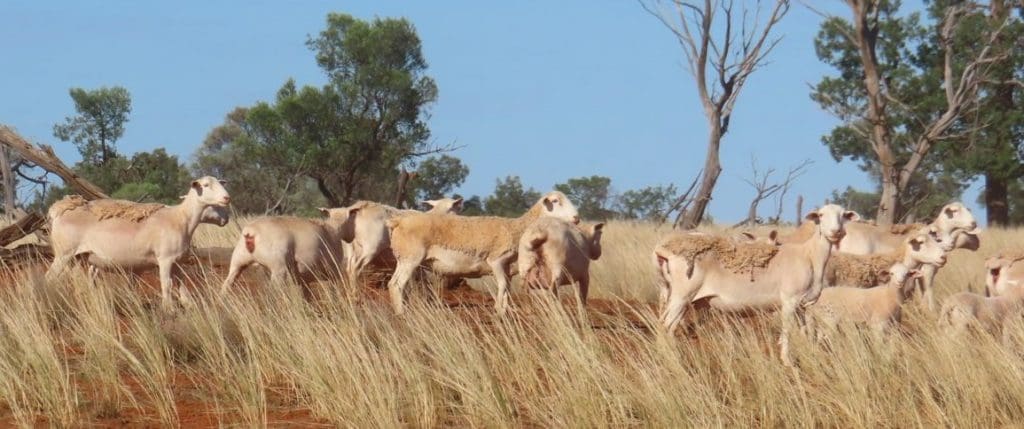
Shedding sheep on western New South Wales rangeland country.
SELF-REPLACING shedding sheep enterprise gross margins came out ahead of wool and first cross flock prime lamb returns in 2025, according to a recent analysis from the NSW Department of Primary Industries and Regional Development.
The analysis has highlighted the importance of managing enterprise costs, with replacement purchases and wool harvesting remaining the two largest cost categories for most sheep businesses, while highlighting the value of reproduction performance.
Sheep enterprise profits surge in 2025
The new gross margin calculations based on average prices between April and September last year have shown sheep enterprise profitability almost doubled year-on-year, with strong livestock prices driving significant gains across all major production systems.
“Sheep sales were the biggest drivers of the gains that we saw and surplus ewes are a big part of that, so reproduction is important,” NSW DPIRD sheep development officer Geoff Casburn said.
“Those operations that were self-replacing saw a kick as a result of those surplus ewe prices.”
The analysis found average sheep enterprise gross margins increased to $43.73 per Dry Sheep Equivalent (DSE) in 2025, compared with $24.53 per DSE in 2024.
The self-replacing Dorper enterprise with no wool harvesting costs assumed emerged as the highest performing sheep enterprise, delivering a gross margin of $60.43 per DSE, followed by a 1st cross operation (buying replacements) with ewes joined to terminal rams at $53.70 per DSE.
Mr Casburn said income was the primary driver behind the improved results, a substantial increase in sheep sales last year.
“2025 was an exceptionally strong year for sheep enterprises, largely due to higher livestock values across a range of classes, including slaughter lambs, surplus ewe hoggets and Merino wether weaners,” he said.
“The self-replacing Dorper enterprise experienced the best of both worlds, benefiting from strong slaughter lamb prices and increased surplus ewe values while maintaining the lowest costs across all enterprises at $31.87 per DSE.
“The next best result came from 1st cross ewes joined to terminal rams, highlighting the continued strength of prime lamb production systems,” Mr Casburn said.
Merino enterprises also recorded strong improvements in 2025, with the self-replacing 20 Merino enterprise achieving a gross margin of $50.46 per DSE, while the 20 micron ewe enterprise joined to terminal rams returned $49.70 per DSE.
The analysis found sheep sale income increased substantially compared with 2024. Sheep sale income for self-replacing 20 micron and 18 micron enterprises increased by 102 per cent and 91 per cent respectively, while slaughter lamb values rose by about 37-42 percent.
Livestock sales topped wool income for impact
Mr Casburn said wool income also improved in 2025, although gains were more modest than those achieved through livestock sales.
“Merino enterprises recorded wool income increases of between seven and 12 per cent, while the 1st cross ewe enterprise achieved a 25 per cent increase in wool income,” he said.
“While livestock sales were the biggest contributor to improved returns in 2025, wool remains an important component of enterprise profitability.”
Wool operation gross margins increased in early 2026
The gross margin analysis found that for the 18 micron self-replacing Merino enterprise, wool contributed around 28 per cent of total income under 2025 assumptions.
Using average wool values achieved during the first half of 2026, wool’s contribution would increase to 49pc of income, lifting the gross margin from $49.47 to $66.23 per DSE. Mr Casburn said up until the significant increase in wool prices after September last year, the increase in wool prices had been about 12pc on the previous year. No comparative self-replacing Dorper and prime lamb gross margin analysis have been done for early 2026.
“In terms of these other enterprises, I don’t think things would have changed too much, with only slight increases in sheep values.”
Wool harvesting accounted for about 28pc of total costs in Merino breeding and wether enterprises, while replacement purchases represented 38 to 40 per cent of costs in enterprises relying on purchased replacements.
“Gross margin sensitivity analysis shows how strongly enterprise profitability can respond to changes in production and market conditions,” Mr Casburn said.
“For example, in a 1st cross ewe enterprise, increasing weaning percentage from 118pc to 148pc lifts the gross margin from about $54 to more than $72 per DSE.
“Similarly, a 50pc increase in adult wool value doubles the gross margin of an 18 micron wether enterprise,” he said.
“Strong livestock markets have underpinned excellent returns during 2025, but producers should continue to monitor costs, productivity and market signals to maximise profitability and build resilience against future fluctuations.”
Mr Casburn said it is unknown what impacts the forecast El Niño will have on supply, markets and prices.
“We see it commonly where supply and demand is obviously king, so when we get dry periods and we see people sending sheep markets and prices fall, producers have got to think really seriously about ‘the bird in hand’; because we can see quite large shifts in sheep values when the market gets swamped.”
Mr Casburn said there are supplementary feeding components in the ten gross margins DPIRD does, and these are not based on putting lambs into containment areas for finishing.
“But what I would say for sheep enterprises, things are good and the actual cost of grain hasn’t gone up a lot, so it makes sense to me that with meat prices increasing significantly over the years and grain price hasn’t, the actual cost of feeding has been relatively stable.
“So you would like to think that if you are going to make dollars out of finishing lambs, these are the years that that is going to happen.
“Again it depends on how much you pay for them and whether you lock in markets.”
Mr Casburn said the analysis did not include a self-replacing composite ewe enterprise component, although a self-replacing shedding sheep business was similar, but with lower shearing costs.
“So it’s not a perfect system and people need to do their own gross margins I suppose is the main message.”
NSW DPIRD publishes 10 sheep gross margin budgets covering a range of wool, meat and dual purpose enterprises. The budgets are based on average prices and costs from April to September 2025 and are designed to help producers compare enterprise performance and test the impact of changing assumptions.
To view the full list of sheep gross margin budgets and a more detailed analysis of returns for 2025 visit the NSW DPIRD website.
HAVE YOUR SAY