
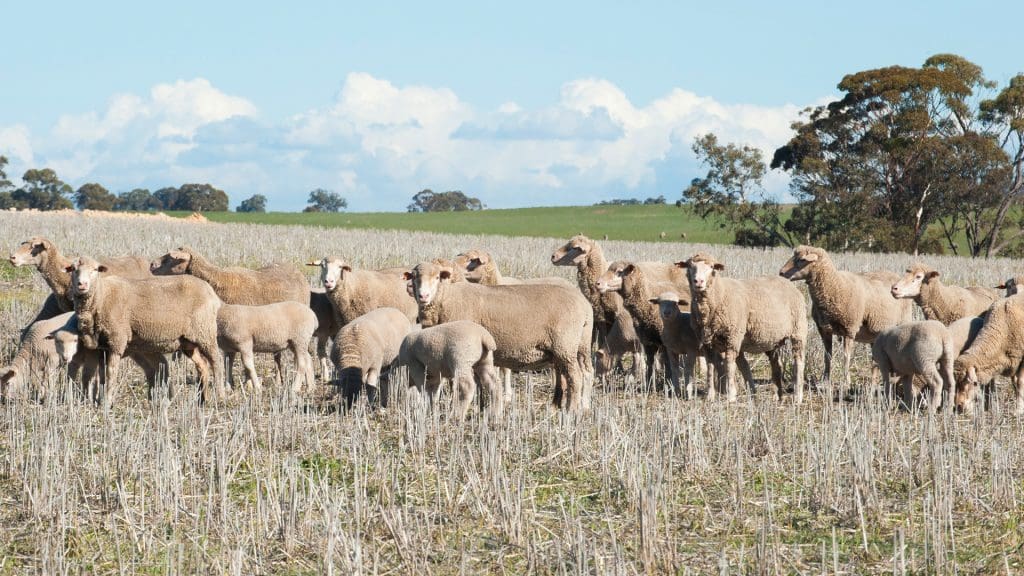
WA Merinos on crop stubble. Photo: DPIRD
BOOKED out events organized by Western Australia’s Wool Collective of brokers and exporters next month indicated strong interest in maintaining a sustainable wool industry in the state, according to WA wool exporter and collective spokesman Peter Morris.
About 350 Western Australian wool growers and industry service providers have registered to attend seminars at Katanning and Brookton next month that promise first-hand insights into the Chinese and European markets.
Two major Chinese processors, Jinmeng and Tongwei will attend the booked out 12 August seminar at Katanning and at Brookton on 13 August. The processors combined use more 180,000 bales of Australian wool annually.
Mr Morris said the collective had initially expected to get 60-70 people at the events.
 “But we’ve just been blown away and embarrassed a bit that we haven’t been able to cater for a larger number of people, but unfortunately there were time and location limitations.
“I think we could have filled it two or three times over, by the sounds of it.”
He believed the popularity of the seminars was a barometer of the confidence in the industry. The seminar will also include Swan Wool exporter Paul Foley’s insights on the European market, grower accounts from the recent tour to China and a brokers’ overview of the sheep and livestock industry.
Mr Morris said people from throughout the wool and livestock supply chains, plus agricultural school students, service providers, bank managers and government representatives will attend the seminars. The aim is to make the seminars as interactive as possible, with short presentations and plenty of time for questions so participants can get the information they need for their business, he said.
“The biggest reason is to make sure that people who are thinking about the production of wool are making the right commercial decision to either maintain or increase their flock, or whatever they want to do.
“This is hopefully giving people information that they can use.”
Mr Morris said he is the most optimistic about the future of Australian wool than he has ever been. He said the industry has previously been reliant on the suiting business, but wool price rises prompted processors to increase synthetic fibre use. But he said wool use for next-to-skin base layers, active wear and in cotton blends is now growing to provide other markets.
“We’ve never had that before.”
Processors and growers want wool price stability
Mr Morris said the recent 4-5 percent dip in the market recently was seasonal and not significant, and especially in the context of its rise in the past 18 months, with new orders expected to come through in coming months.
“The (Chinese processors) have purchased more wool this last year than they did the year before, including a lot of wool on hold from growers.
“Everyone in India, Europe and Asia is aware that this year there will be 10-12pc less wool up for sale,” he said.
“Everyone gets it, no one is delusional about that and they are all still confident that demand is good.
“In the meetings that I’ve had this week (in China) price is not a conversation point; they’re not worried about where the price of wool is at the moment,” he said.
“The main thing they want it to be is stable, that’s their main issue; stability.
“And they think it is sustainable at these levels for the forseeable future,” Mr Morris said.
“It will take an event for the price of wool to change.”
Mr Morris said he believed the “penny has really dropped” with overseas manufacturers and processors realizing that for the first time there is no substantial volumes of wool “on-hold” in storage in Australia.
On the ground in WA, Mr Morris said based on his contact with growers since the June tour, they also wanted stability in pricing.
“They are looking to make sure that these prices are maintained and I think the mood in WA is positive.”
He will have a much clearer picture of the level of industry confidence after the Katanning and Brookton seminars.
Mr Morris said seminar participants will be asked if they would like more similar events.
“If the growers want it, yes we will do it.”
The seminars were organized after the collective concluded a tour of Chinese processors with a group of WA growers and industry people in early June, when the national and western market indicators were about 100cents/kg higher.
After that tour, growers returned with renewed confidence with several growers — including Chillakerup Farms’ Sam Beech – expressing renewed confidence after talking with processors and viewing the level of investment in processing in China.
After the China tour, Mr Beech said the future of wool is bright and he told Sheep Central this week the recent dip in auction prices wasn’t a concern, but that processors needed to understand that wool needs to be profitable for growers.
Mr Beech said there are growers who can grow wool profitably under 2000c/kg, but for supply to grow at the rate that the Chinese want and need it to grow prices would need to be maintained around that level for wool production to compete with other land uses. He also said it is important for the WA wool industry to continue the grower to processor communication made possible by the WA Wool Collective.
HAVE YOUR SAY