
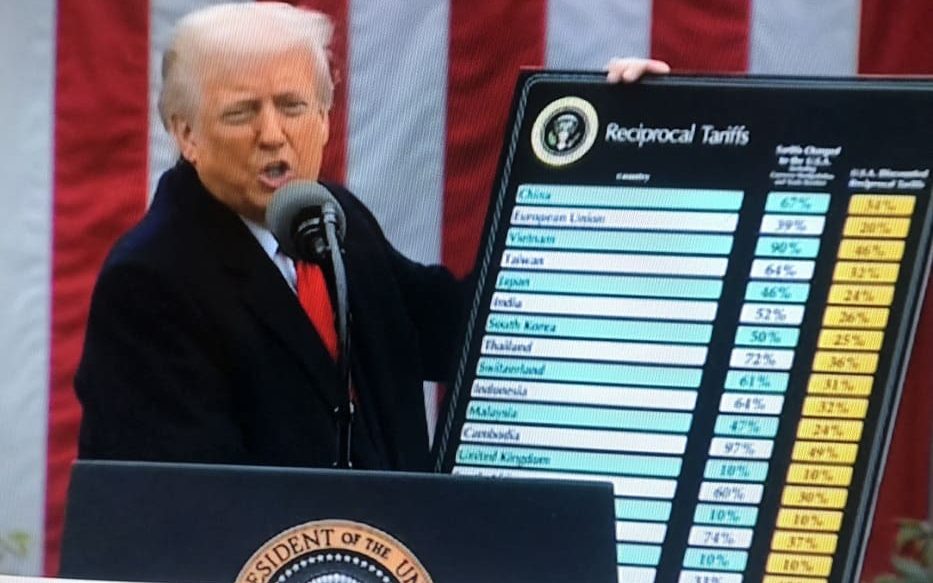
US President Donald Trump has instituted a 12.5pc tariff to replace his previous 10pc reciprocal tariff on certain countries.
AUSTRALIA’S lamb export sector has this month been hit with a double whammy in potential trade restrictions with a new 12.5 percent tariff being levied by the United States and the US International Trade Commission investigating the impact of imports on the American market.
Analysts indicate the effective 2.5pc increase in tariffs – from 10pc to 12.5pc — on all sheep meat products from Australia is unlikely to significantly impact US import volumes.
But they said the possibility of tariffs of up to 30pc arising from the separate USITC investigation into the effect of lamb imports on the US domestic sheep production and processing industry could impact Australia’s exports to the US.
US trade representative Jamieson Greer yesterday said, at President Trump’s direction, a 12.5 percent tariff will be applied to a range of goods from Australia and other countries under Section 301 of the Trade Act of 1974 after accusing them of failing to adequately police forced labour in its supply chains.
For the fiscal year ended 30 June, the US was Australia’s largest beef export market (493,000t), largest lamb market (85,200t) and largest goat meat market (30,776t).
‘Business as usual’ as demand stays strong – Quilty
Global Agritrends analyst Simon Quilty said Australia’s sheep meat import business into the US would be “business as usual” despite the extra 2.5pc tariff.
“The market, importers and end users will absorb it at the other end – nothing changes as we go from 10 to 12.5pc.
“What’s interesting is that right now the US domestic lamb prices are at record levels and imported Australian lamb cuts are trading at anywhere between 15-25pc premium over this time last year.
“Certain cuts are definitely (trading) below domestic product, and demand remains unbelievably strong,” he said.
However, Mr Quilty said a 30pc tariff on Australian sheep meat imports into the US could make a difference to import volumes.
“We are seeing in the monthly retail sales in America that there is a bit of pushback at these dizzy prices, so the volume that is now traded has fallen by double digit figures for the month.
“So there is no doubt that lamb prices in America are trading domestically at three times the value of pork and chicken at retail and we’ve had consecutive months of rising prices.”
He said US domestic lamb prices in May were up 19pc year-on-year.
“So I think what happens is that when you get to these very extreme prices rationalisation occurs and the market … I still see rising prices but fewer buyers because it is starting to expensive.
“Has demand fallen, no, it’s just that fewer people can afford it, but those that can are continuing to buy,” he said.
Mr Quilty said the market will continue to be underpinned by restricted sheep meat supplies this year, 2027 and 2028, with lamb and mutton supply bottoming out next year.
Other market issues a concern if US demand drops – Dalgleish
Episode 3 analyst Matt Dalgleish said he also did not expect the extra 2.5pc tariff to significantly impact Australian sheep meat imports into the US.
“You may see a little softening, but my only concern is that we’ve got, from a sheep meat export perspective, China for most of the year has been a bit subdued, and obviously the Middle Eastern region has been problematic, although better than March and April in terms of flows.”
He said it would not be a great scenario if US demand started to get more subdued.
“The US market has been the one that has been kind of keeping total sheep meat exports at least at average levels.”
Mr Dalgleish said it is not uncommon for markets to quieten during the high price winter period.
“This might just add to that a little bit, but I don’t think it is going to be a significant impact.
“You might see the price pressure from these levels coming off as we head towards spring; it might just start the downward movement of pricing before the spring flush comes …”
He said the long-term global sheep meat supply shortage situation is unchanged.
“(The 12.5pc tariff) is not ideal from a free trade perspective is not ideal, but there are so many factors at the moment in favour of the producer; the season has been brilliant and there is a lot of feed, even with the concern of a possible super El Nino into next year.”
Mr Dalgleish said the USITC investigation is the only “significant back cloud” over the industry at the moment.
“And just because of the unpredictability of the Trump regime that if he comes and makes some rash decision around Australia … that’s the only risk.
“We’ve got 12.5pc now and that might be challenged anyway internally.”
Mr Dalgleish said the imposition of a 30pc tariff as sought by the American sheep industry from the USITC investigation would be “much more problematic.”
“And knowing how unpredictable Trump is, if there is some kind of negative outcome from the investigation … that’s the bigger concern from me as to how this plays out and whether they look at it objectively.”
Mr Dalgleish said the decline in the US sheep and lamb industry began in the 1990s and production has been stable for the past decade. This meant the US sheep industry did not have the capacity to supply the growth in lamb demand, he said.
“There is plenty of opportunity for the American sheep meat industry to piggyback on the quality of Australia and New Zealand product and have more Americans eating sheep meat and becoming more familiar with it – it would help everyone.”
US tariff unjustified – Farrell
In a press conference today Minister for Trade and Tourism Don Farrell said the Australian Government was disappointed in the decision of the United States Trade Representative to increase tariffs on some of Australia’s products going into the United States.
“We do not believe it was justified.
“We believe that amongst all of the countries in the world, Australia does take the issue of modern slavery seriously, and will continue to do that,” he said.
“But we think, and we believe, the Albanese Government believes that this imposition of higher tariffs on Australia is completely unjustified, and we will continue to lobby the United States Trade Representative to remove all tariffs on Australian goods.
“Now, there is a small paradox here that in the period since the so-called Liberation Day last year, Australian exports to the United States have increased, and we are now exporting 67pc more products into the United States than before the so-called Liberation Day,” Mr Farrell said.
“But we continue to maintain that these tariffs are unjustified. Australia is a country that deals with the issue of modern slavery seriously. And from my point of view, the government’s point of view, we will continue to argue very strongly for the removal of these tariffs.”
AMIC objects strongly
The move has prompted a strong objection from Australian Meat Industry Council chief executive officer Tim Ryan.
He said the measure that is “unjustified, inconsistent with the Australia-United States Free Trade Agreement and fundamentally fails to recognise Australia’s world-leading record on labour standards and worker protections.”
“The U.S. Trade Representative’s final determination under its Section 301 forced labour investigations imposes a 12.5pc tariff on Australian sheep meat and goat meat exports to the United States, increasing the effective tariff burden from 10pc to 12.5pc.
“The decision follows investigations, public consultations and hearings conducted throughout 2026 and which ignored the strong and robust case put forward by Australia in defence of our labour policies, which the US government has itself rated as world-leading,” Mr Ryan said.
“Australia has a robust, world-leading regulatory framework to address modern slavery and forced labour across supply chains.
“The Australian meat industry operates under stringent workplace and compliance requirements, providing confidence in the integrity of our production systems,” he said.
“Ultimately, the ongoing and increased tariff on protein imports will increase costs for American importers, retailers and consumers while also undermining a long-standing and mutually beneficial trading relationship between Australia and the United States.”
Trump finds another way to impose tariffs
The office of the USTR last month initiated 60 Section 301 investigations related to the failure of various economies to impose and effectively enforce a prohibition on the importation of goods produced with forced labour, determining that 54 economies have failed to impose and/or effectively enforce a forced labour import prohibition — including Australia, New Zealand and China.
The new 12.5pc tariff on lamb, mutton and goat meat imports into the United States, and wool products from China, has come after the expiry of the current 10pc tariff on imported products on 24 July, following the US Supreme Court ruling that US President Donald Trump’s tariffs introduced under the International Emergency Economic Powers Act were illegal.
Despite representation from Australia that it had world leading legislation addressing forced labour and modern slavery, and was making further improvements, President Trump has proceeded with the 12.5pc tariff hit on Australia. Beef imports are exempt from the new tariff.
Mr Greer said imposing tariffs on 60 economies for their failure to impose and effectively enforce a prohibition on the importation of goods produced with forced labor.
“President Trump recognizes that decades of moral suasion have not eradicated forced labor from global supply chains.
“The United States has had a forced labor import ban for nearly a century, and rigorously enforces it; it’s well past time for our trading partners to do the same,” Mr Greer said.
“Today’s action will begin to correct what is both a human rights abuse and distortive trade practice to improve the welfare of workers everywhere.
“I am encouraged by the trading partners who have moved quickly to adopt forced labor import prohibitions, and look forward to ensuring their effective enforcement.”
NFF: Ag sector deeply disappointed
The National Farmers Federation said it was deeply disappointed in the decision.
“The new, increased tariff represents a further and unnecessary trade barrier between two trusted allies with a long-standing agricultural and economic partnership underpinned by the Australia-US Free Trade Agreement, which provides for zero tariffs on two-way trade,” it said.
NFF chief executive officer Michael Guerin said the decision was a step in the wrong direction.
“Australian agriculture is profoundly disappointed by this announcement,” Mr Guerin said.
“Rather than moving back towards the free and fair trading arrangements that have served both our countries well for two decades, the US has chosen to further increase barriers to trade, despite Australia’s longstanding record of high standards and responsible trade.
“The increase adds further challenges for Australian exports, particularly given a number of other economies received a lesser tariff of 10pc.
“The NFF has long championed free and fair trade, not just for agriculture but all industries, recognising its role in global economic growth, stability and food security. Australian agriculture is unwavering in its commitment to this.”
Mr Guerin said Australian agriculture remained committed to a considered and measured approach.
“Australia’s interests are best served by pursuing open markets, maintaining our reputation as a trusted and responsible trading partner, and continuing to strengthen our trading relationships around the world.
“While some major agricultural exports appear to remain exempt, including Australian beef, today’s decision is nevertheless a disappointing setback for Australian exporters.
“Australian farmers are among the least subsidised in the world and have built a global reputation for producing high-quality, sustainable and reliable food and fibre. We will continue working with Government and industry to ensure Australia’s trade interests are protected and to expand opportunities in markets that value the quality and integrity of Australian agricultural products.”
The USTR Docket Notice regarding the 12.5pc tariff, and exemptions, can be read here.
President Trump to decide after USITC investigation
USITC secretary Lisa Barton said the commission’s investigation, under section 202 of the Trade Act of 1974 (the “Act”), would determine whether lamb meat is being imported into the United States in such increased quantities as to be a substantial cause of serious injury, or the threat thereof, to the domestic industry producing like or directly competitive products.
The USITC has determined that this investigation is “extraordinarily complicated,” and will make its serious injury determination by November 13, 2026. The commission will hold a hearing on serious injury on October 16, 2026 and in the event it makes an affirmative serious injury determination or is equally divided on the question of injury in this investigation, it will hold a hearing on the question of remedy on December 1, 2026.
The imported articles covered by this investigation are defined as fresh, chilled, or frozen lamb meat. Live animals and mutton are excluded from the investigation. The notice of institution [PDF, 5 pages] provides specific details regarding the scope of the products at issue.
The USITC will submit to the president the report required under section 202(f) of the Act within 180 days after the date of the request, or by January 11, 2027.
Ms Barton said if it makes an affirmative serious injury determination, it will recommend a remedy to President Trump.
“The president makes the final decision on whether to provide a remedy to the U.S. industry, and if so, the nature and duration of the remedy.
”The remedy is temporary. The initial period of relief cannot be longer than four years, and if extended, the full period of relief cannot exceed eight years in the aggregate.”
Ms Barton said when a petition or request is filed, the USITC must determine whether an article is being imported in such increased quantities as to be a substantial cause of serious injury or the threat of serious injury to a U.S. industry.
“Global safeguard investigations do not require a finding of an unfair trade practice such as under the U.S. countervailing duty law (a foreign subsidy) or the antidumping duty law, it said.
She said global safeguard investigations are not country specific.
“They involve imports of the products under investigation from all sources.
“However, Commissioners who make affirmative injury determinations are required to make additional separate findings for certain countries with which the US has free trade agreements.”
These include the USMCA countries (Canada and Mexico), Jordan, Australia, Colombia, Korea, Panama, Peru, Singapore, the CAFTA-DR countries, and Israel.
Never mind the south American sheep herders they exploit. Some at the end of their three year contracts never leave.