
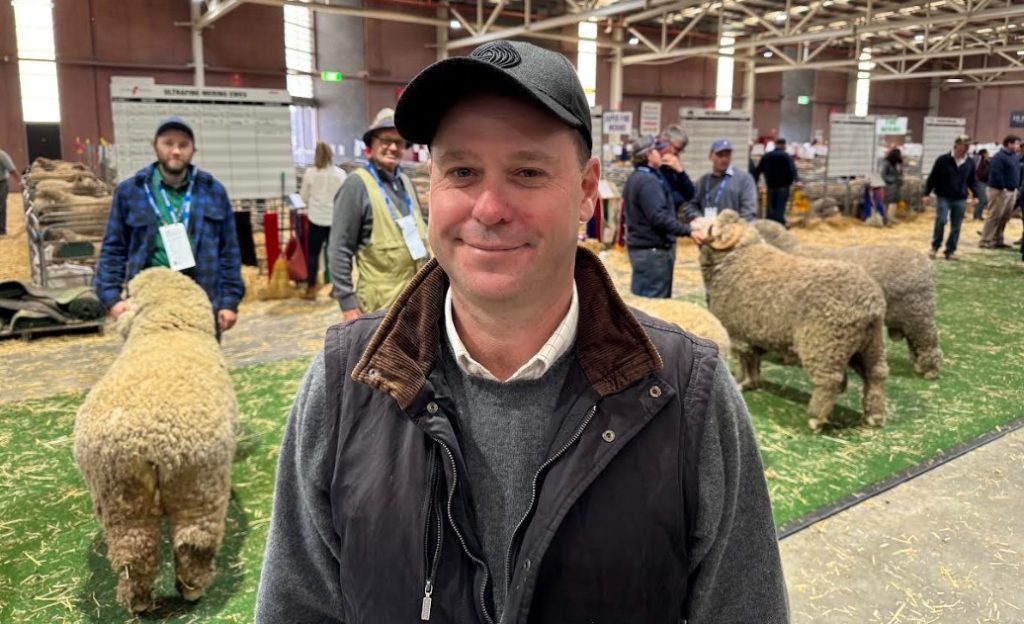
AWI chairman George Millington at the Australian Sheep and Wool Show in Bendigo last week.
AUSTRALIAN Wool Innovation chairman George Millington has pushed back on industry talk around the rationalization of industry bodies.
Discussion on the need for fewer competing representative voices and stronger, more unified industry leadership has featured in the recent Future Flock consultative process.
This culminated in Future Flock national advisory panel chairman Angus Hobson, under his ‘wool grower hat,’ commenting at LambEx on whether the sheep and wool industry would benefit from consolidation of groups like WoolProducers Australia and Sheep Producers Australia, or the research and development corporations, AWI and Meat & Livestock Australia.
Mr Hobson told the Weekly Times the FFS was “not going to prescribe” but would aim to “put some beacons on the horizon”. He said “one of the things that hopefully falls out of this is, ‘hey, look at this, the plethora of entities here’.”
“I’m hoping that people start talking about rationalisation and single bodies, I personally hope that’s one of the conversations that comes out of this process.
“I have no idea whether it comes out in one or in five years, we’re not in the business of pushing policies in the Future Flock,” he said.
“We kind of want to present a body of evidence so people can come to that conclusion.”
FFS is policy, but growers want AWI separate from MLA – Millington
Mr Millington was selected for an interview as part of the FFS process, but said the FFS report released at LambEx was a policy document and he would only talk about FFS in general terms. The document said a future industry unity imperative was “creating greater alignment with a shared direction for Australia’s sheep industry.”
“It’s a policy document, we’re an RDC – we are happy to co-operate with any organization like Future Flock that wants to have as much information about the market, what’s going on overseas, what producers are doing – all the different things that we’re to do to assist them,” Mr Millington said.
“You’re talking about a policy document; we can’t actually comment on that according to our Statutory Funding Agreement (with the Federal Government).”
Mr Millington also would not be drawn to comment on FFS feedback and references on mulesing, maintaining AWI’s so-called agnostic position on the issue.
“Correct, we’re an RDC, we’re here to benefit all wool growers, we’re here to do research and development on behalf of all wool growers to assist them and then actually assist in demand creation and defending the fibre overseas.
“We’re not going to take a position, Future Flock is a policy document engaged by the government – talk to the authors, talk to the people who put it together.”
However, when asked separately about the issue of industry body rationalisation, Mr Millington told Sheep Central he could not speak for the policy bodies such as WPA and SPA.
But in relation to research and development corporations like AWI, he believed “levy payers and wool growers really value having one independent wool authority that is separate to Meat & Livestock Australia that can do research and ensure market access for wool and wool alone.”
What can growers expect from AWI this year?
When asked at the Australian Sheep and Wool Show in Bendigo what growers could expect from AWI this year, Mr Millington said the levy-funded body just had to “keep on keeping on.”
“Again as you know AWI is an RDC, we’re here to make wool growers’ businesses more productive, more profitable, so we’re going to continue to invest heavily in on-farm research.
“We’ve got 14 different projects on the go regarding flystrike and all different things from sterile flies to nanotechnology, tea tree oil, vaccine – all actually showing quite a bit of promise.
“So our job is actually just continue to chip away behind the scenes on behalf of wool growers to try and add value,” he said.
“Both in what we do in terms of Woolmark overseas, demand creation, defending the fibre, advocating for wool in foreign markets and advocating with foreign governments in the EU to make sure wool is painted in the best possible light – Make The Label Count, all that sort of thing.
“And then as I said going back to what we’re doing on farm and actually trying to make farmers more productive, continuing I think to run with sort of third year of our revamped extension program with the industry relation officers,” he said.
Mr Millington said AWI is getting really good responses in terms of its workshops on RAMping Up Repro and how to transition to a non-mulesed flock.
“Lifetime Ewe Management continues to be incredibly popular and I think has been responsible for some of the largest productivity gains in the sheep industry across the board.”
Mr Millington said AWI had more things coming in new extension programs that he believes will continue to increase productivity and work with finalised research.
The AWI chairman said the organisation has been doing some work in the sustainability space and hoped to make some announcements around Woolmark + in the next 2-3 months. He said Woolmark + is not a certification scheme, but complementary.
“It’s all about enabling people who are manufacturing clothing in the supply chain to inset their (greenhouse gas) emissions within their own supply chain and actually enabling farmers to be able to sell their story and explain what they are doing on farm and enabling them to actually make some money.”
Is a wool price benchmark of 2000c/kg clean enough?
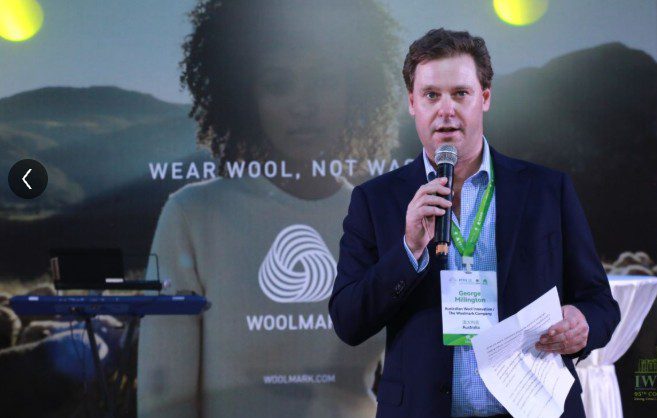
AWI chairman George Millingon at the IWTO 95th Congress. Image – IWTO, LinkedIn.
Mr Millington said in the previous three years the Australian wool industry had experienced unsustainable pricing “and farmers who are running a business and deploying capital have decided to actually move their production system away from wool.”
“There is no doubt we’ve lost acres.
“We are now seeing a more sustainable price, as to where that can go in the future, I don’t know; I’m not here to predict prices.”
However, Mr Millington said he had spent the last two weeks in China, visiting early stage processors, garment manufacturers and brands. He also presented at the International Wool Textile Organisation’s 95th Congress in Dalang, China, last month.
“I can tell you they are continuing to invest heavily in more machinery and more capacity.
“We are seeing excellent feedback from over there that they see even more growth in the next-to-skin, athleisure wear knitted product as opposed to the traditional woven products,” he said.
“I visited a couple of different processors who were making that sort of product and they were exporting 75 percent of that five years ago, about 50pc of their production is currently going into the domestic market and they are saying it could be up to 65pc domestic within the next three years.”
Mr Millington said these developments definitely help lift prices to wool growers.
“Again wool is a commodity, it’s a demand/supply driven thing.
“There is no doubt, we have to be honest with ourselves, one of the things that we’ve seen (is) the price go up recently over the last six months as the processors overseas have realised there is a diminishing clip in Australia because we’ve lost kilos,” he said.
Mr Millington said in contrast to the lamb market, the wool supply chain is extremely long and with a lot of costs, and the raw price of wool is only one component.
“So you would have to say there is more ability in the (wool) supply chain to absorb higher prices and that’s the feedback we’re having from overseas as well.”
Mr Millington said AWI had hosted quite a few events in China, with attendees at one event responsible for buying about 75pc of Australia’s wool clip.
“And I can tell you that the team at AWI and Woolmark made it expressly clear that farmers have choices when they are running their business – if they don’t receive sustainable prices they will change their production systems and grow another commodity.
“And all I can tell you is that we made that incredibly clear and we were told that we were listened to.”
Mr Millington said the dual purpose traits of the modern Merino meant the current meat markets would always be the wool industry’s friend and were helping growers.
“Absolutely anytime the meat market is a wool grower’s friend.”
He believed there would be some switchback to running more Merino wethers, although there would be stiff competition between processors and restockers in saleyards.
Mr Millington said AWI had collaborated with MLA on studies that had showed the superior eating quality of Merinos, but there was still untapped potential to develop the meat marketing potential of Merinos around eating quality.
“I think one of our stated aims should be to actually work with MLA to actually try and achieve a (sheep meat) premium for those (Merino) growers and not a discount – absolutely huge potential.”
Mr Millington was attending his first Australian Sheep and Wool Show in Bendigo as AWI chairman this year and said it was good to see good sustainable prices for wool, record high prices for lamb and mutton.
He said it was good to see the level of optimism among wool growers who are being rewarded for choosing to stick with the “tried and true” dual purpose wool-meat income production model.
“And that they actually perceive that there is a real future for the industry and for the next generations within their business – that wasn’t here three years ago.”
Just to be clear, the Future Flock is not a policy doctrine – that’s not within the project’s remit. However, TFF is designed to provide a body of (objective) evidence to help guide investment (public, RDC, private) and policy development for the industry’s future (10+ years).
While I have a personal (levy payer) view on the efficiency and efficacy to be gained from a level of rationalisation across the ag sector — not just the sheep industry — the Future Flock’s aim is purely to present data and scenarios to help the industry make informed decisions.
As far as future structural arrangements of the industry are concerned, they should obviously be made based on what delivers the best results for the industry. Form should always follow function.
I would hope that anyone with even a cursory eye on the decades-long trajectories of the Australian sheep flock, and its underlying sheep meat and wool production levels, would at least consider that perhaps the current arrangements are not best (most efficiently or effectively) meeting the interests of the sheep industry and/or at least one of its component commodities. Again, that’s a personal view, but hopefully one that’s not too outlandish given the data available.
There are legitimate areas of criticism of the Future Flock, but the intent to address these types of issues head-on, and to set a course of long-term prosperity for the sheep industry, is not one of them.
This is an important juncture for the wool industry in particular, and I personally hope the Future Flock can at least help turn it into an opportunity.