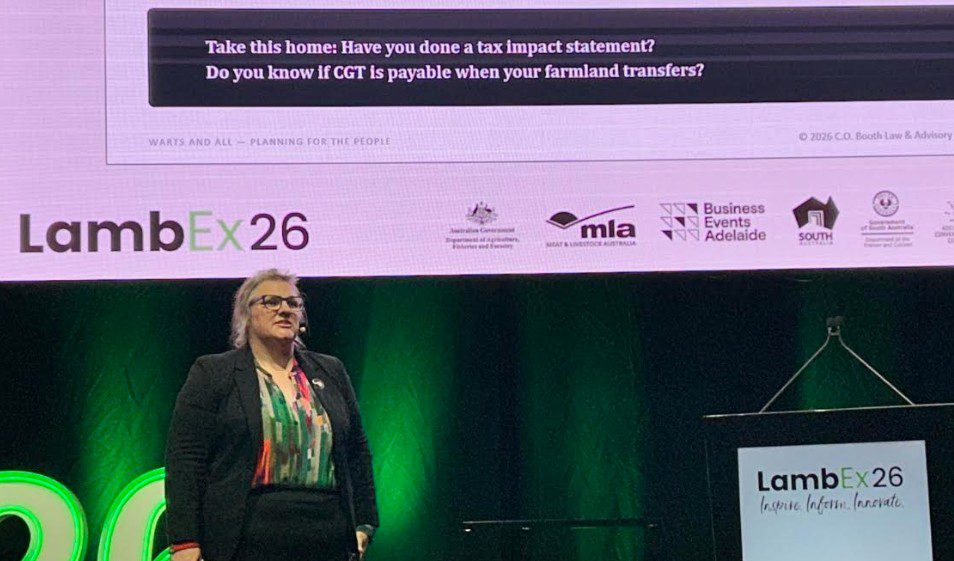
Succession lawyer Claire Booth gave some valuable take-home tips at LambEx26.
SHEEP producers without a tax impact statement risk losing up to 20 percent of their balance sheet post-federal Budget, a succession lawyer told last week’s LambEx conference in Adelaide.
“Other people, who have done the tax impact statement might be able to get a 3pc reduction in their balance sheet,” said straight-talking Claire Booth.
Ms Booth also issued a warning to producers giving artificial intelligence programs access to farm business data and information.
The Nuffield scholar is a producer of grains and horticulture as well as running 800 Angus steers and some trade lambs, and urged fellow-farmers to get a tax-impact statement “like an environmental impact statement”.
“We understand now, particularly after the last federal Budget, that assets have serious values and when we see those as being taxable values, I’m seeing consistently devastating consequences.
“And what I find the most frustrating is the lack of accountability by my gorgeous colleagues in the accounting profession because ultimately the accountants are saying: ‘Of course if they’d just asked me, of course I would have advised them, but they never asked me to advise them’,” she said.
The problems with succession planning on the run
Ms Booth said that more than half of the claims she deals with are triggered by either illness or death, “which is never how you want to do tax planning”.
She listed the problems of succession planning on-the-run.
“There’s no date or a committed range as to when someone’s going to potentially retire or transition to semi-retirement.
“They have no idea how much it costs for them to live,” she said.
“They genuinely do not understand if the farm can afford to fund their retirement.
“And they certainly have no idea how much it’s going to cost for aged care, palliative care and that transition to death.”
Having worked as a lawyer for more than 20 years and now, also as a wife and mother of two young children, Ms Booth is co-running a farming enterprise that turns over more than $10m.
“We have a succession plan and that is that we both must cease being trustees of trust structures at the time we reach 60, and our children now know how much debt they will take on at their 21st birthdays!”
She detailed the moment when she realised the fundamentals of succession planning.
“It was a Sunday morning, I think it was raining and we were at home. I was reading the newspaper.
“I remember the kids were playing on the carpet. They had toy tractors and plastic sheep and cattle.”
Ms Booth recalled how her son, who is otherwise a ‘kind young man’, said to his sister: “This farm is mine.”
Her daughter looked affronted and said: “But Mum and Dad said we’ve got to share.”
The boy replied: “No it’s all mine. Go and do something else.”
Ms Booth had a chat with the lad saying: “Hey, this carpet is huge we can share everything and, with time and information, you can all have enough.”
“It was a moment when I actually realised that succession was happening in my life.
“It was moment when I realised that I could say something, or I could say nothing,” she said.
“I see other siblings behaving towards each other in traumatically ugly, ostentatious, arrogant, greedy, mean, weaponising gender-norms or just genuinely not having a backbone.
“I see, in my meeting room and when I’m in the courtroom, I see the consequences or the relationships and the behaviours between those siblings,” Ms Booth said.
“Please – what standard are you walking past if you say nothing?”
Ms Booth drew on her experiences from clients nation-wide to share the three major pitfalls she sees in succession planning.
“It’s really about money and it’s 100pc about the anxiety of running out of money.
“Most people haven’t got a cash flow plan for mum and dad’s retirement,” she said.
“And normally mum and dad actually don’t do their own personal cash flow because normally the business pays for a few things and they pay for a few things.
“But unless you, whether it’s at 50, 60,70, 80 years – unless you know how much it costs for you to run as a husband-and-wife team, how the hell is the business meant to know how to fund you?,” Ms Booth asked.
“If you can’t measure it, how can we determine if we’re doing it well?
“If we can’t measure it, how can we place it into a document? And if we can’t measure it, how can they ensure that the document is enforceable? And if we can’t measure it, how can we create trust?,” she said.
“People can’t give away things until they know what they need to keep.
“The second thing I’ve noticed is that the plan doesn’t normally fail because the paperwork is bad, but if conversations are rushed,” Ms Booth said.
There’s an entire consulting industry that says ‘this just takes a day and then you can swing it past the accountant’ or ‘just use Claude AI or ChatGPT. Those lawyers – they’re bastards, they will absolutely rip you off for every single cent’.
“The plan doesn’t fail on paper, it’s usually because the conversations were rushed and some people somehow think that a will and a power of attorney are all the documents that you need,” she said.
Avoid handing information over through AI
Ms Booth stressed the need to avoid handing information to unknown third parties through use of AI.
“Unless you have been under a rock, I’m sure you have heard that the use of artificial intelligence in any part of your business means that you have consented to all of that information no longer being subject to client legal privilege.
“Why the hell would you put your business information of any kind – bank, accounting or legal – into a system that fundamentally says ‘I don’t want to own this data, I’m going to give it to someone who just might’,” she said.
“Once you put it into a large-language model, I love that.
Ms Booth said she can subpoena any information pertaining to a case.
She said told the audience she can demand: “Give me everything that is in your computer. Everything that your accountant sends you, and your banker and your lawyer. Disprove to me that you have used artificial intelligence,” she said.
“So please, next time you think you might save a few dollars skimming over the legal process, please understand the significant role of your privilege in the legal system.”
Start planning succession before you are forced to
Ms Booth said succession planning can be difficult to kick-start.
”Parents that are in their 50s to 70s, somehow they’re stuck in the mud, they’re slow and they don’t want to do it, they’re avoiding it.
“They just can’t somehow disconnect their identity to ownership of the land,” she said.
“Can I possibly say that that might be a paradigm?
“That might be something where you could actually flip it and say: ‘Gee, I wonder if mum and dad have got a menu of options in front of them? I wonder if they understand what things that they can do? And could it be that mum and dad need a coach or someone to implement some things?,” Ms Booth said.
“Could it be that mum and dad are absolutely-fricking-terrified of making the wrong decision and one of their children not loving them any more’?
“The journey of parenting, whether the children are young or old, throw in a couple of million dollars of assets and a bit of debt, it’s a pretty hard project to just tick off.”
Ms Booth said everyone knows succession planning is much more than just transferring assets.
“But please, start before it’s forced upon you.
“Get a tax impact statement and ensure that the team that’s supporting your family is supporting the family and not just the fund.”
HAVE YOUR SAY