A four-year project at Gundagai in New South Wales included NZ-based company Scales Corporation Limited helping connect on-farm EID reading to GMP’s existing hook tracking system.
This SCL input helped GMP’s Gundagai Lamb — with Australian industry funding and resources — deliver the results outlined in the LambEx 2026 AMPC Carcase Showcase.
Gundagai Lamb supply chain coordinator Claire Marriott said the company puts a lot of effort into interpreting the carcase feedback to producers, and electronic identification tags (EID) have become a major part of that.
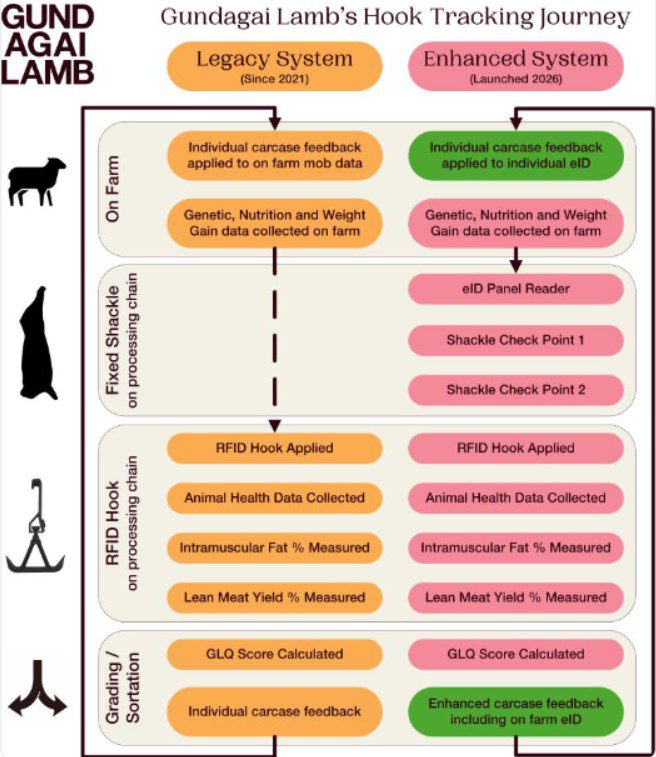
“We’ve been giving individual carcase feedback for around nearly six years now.
“We’ve had hook tracking installed and essentially we’ve been able to track individual lambs and connect an intramuscular fat, lean meat yield, carcase weight, fat score and animal health all back to an individual carcass, which was really good,” she said.
“But the next key piece to the puzzle was connecting that with an on-farm EID (electronic identification).
“So back in April 2022, we installed our first EID panel and over the next few years, we had a lot of trial and error,” Claire said.
“We had a lot of quite a few problems with electrical noise (interference) within the plant.”
At the end of 2024, Gundagai was linked up with SCL founder Dave Wright to install a new system that connected EIDs to the plant’s hook tracking.
One of the activities in the project was to design and deliver full automation as well as improving the EID reader which is now averaging 98-100 percent readability in the trials. The project called ‘Enhancing traceability in small stock processes using hook tracking and the simple implementations for industry’ was funded by the Department of Agriculture, Fisheries and Forestry and the Australian Meat Processor Corporation and finishes at the end of July. The project was delivered by GMP in collaboration with the NSW Department of Primary Industries and Regional Development.
The project grew out of the national mandating of EIDs for sheep and goats and EID scanning encouraging processes to implement hook tracking. There were two main aims of the project, the first one being enhancing the adoption of traceability. The other was to identify and demonstrate the value proposition of full carcases.
SCL founder Dave Wright said the company came from an industrial automation background.
“We don’t look at it in the same way that many other companies look at it.
“We look at it as an industrial process,” he said.
“I think one of the mistakes that people make is that they think that tracking sheep is easy – it’s not.
“It’s a lot harder than cattle mainly because sheep can jump off chains and then reinsert themselves into chains,” he said.
“And being able to handle those anomalies is probably the difference between a good system and a bad system.
“You end up having to track every animal individually,” he said.
“You can’t track them as a as a group or as a FIFO – as we call it – meaning first-in-first-out.
“Each animal needs to be tracked individually right through the system and it’s how you do that is what makes the system at Gundagai different to probably any other system that’s running in this country at the moment,” Dave said.
“We’ve obviously got this kind of technology in a lot of plants in NZ.
“We’ve been taking the knowledge that we’ve got from the last 13 years of working with the those guys and bringing it over to Gundagai to make it work.”
Dave said the beginning of the system is the EID scanner and it’s probably the most problematic part of the whole equation, because eID-RFID antennas are quite large.
“So they’re very susceptible to noise (interference) and you’ve got plants that are very noisy.
“They’ve been developed over many years and they’ve got lots and lots of different technology,” he said.
“And probably some of that technology might not have been put in at what would be considered best-practice nowadays but at the time it was adequate.
“So, tracking down those problems can be very, very difficult and that’s probably one of the single biggest issues with EID.
Dave said SCL has developed some technology around trying to minimise the effect of ‘noise’ and that’s the technology that has been put into Gundagai, althought it doesn’t eliminate it.
“My hat goes off to Gundagai Meat Processors and its trade staff.
“We spent days tracking down issues and then fixing them,” he said.
“Their trade staff came to the party;, they sort of picked up the ball, understood what we were trying to achieve and then and then helped out massively.
“And without that input and that help from those sorts of people who understand the plant and all the electrical devices in the plant, you’re on a hiding to nothing.”
Dave said SCL has had plants where it’s taken months to narrow down where the actual ‘noise’ is coming from.
“We pretty much narrowed it down (at Gundagai) in a number of days,” he said.
“There’s still noise there.
“We’ll never eliminate all of it, but it’s working to a point where it’s acceptable and it gets very, very good results,” he said.
“Most of the non-reads will be down to poor tags or no tags at all, which is another discussion.”
Claire said Gundagai Lamb went live (with hook tracking to EIDs) at the end of March-April and so all consignments that come through Gundagai Lamb now have an EID listed individually with all of the carcase feedback.
“It’s really exciting and we think it’ll be the next powerful tool for our producers.
“This project was four years in the making, so we’re very excited to see it through.”
NSW DPIRD development officer Tracy Lamb worked extensively with GMP on the project and is hosting a webinar on Thursday, 30 July, from 8-9am on ‘Sheep EID & individual carcase feedback: a producer’s perspective’. To register for the webinar, click here.
HAVE YOUR SAY