

Lambex delegates packed the room for the AMPC Carcase Showcase segment
A WORLD-FIRST Meat Standards Australia index for sheep meat has arrived, with at least one Australian lamb processor already preparing to share the model with producers.
Gundagai Meat Processors is creating a model drawn from its feedback systems, the audience at LambEx heard in Adelaide yesterday.
The 1400 delegates also heard that industry-wide MSA grading – the world’s first cut-based predictive eating quality sheep meat model – will be modelled using data from yesterday’s AMPC-led Carcase Showcase.
The world’s largest carcase comparison involved more than 5300 sheep sourced from five states, comprising 69 total entries from 52 producers. Carcases were graded for intramuscular fat (IMF) and lean meat yield (LMY) at three Australian processing plants.
Gundagai Meat Processors was one of the participating abattoirs, as was JBS Bordertown and WAMMCO in Western Australia.
Using MEQ probes and Murdoch University’s microwave measurement system – both of them accredited – the benchmarking exercise offered practical, objective carcase feedback from commercial lambs.
Analysis of the showcase entries revealed that only five producers produced animals that were above-average in LMY and eating quality.
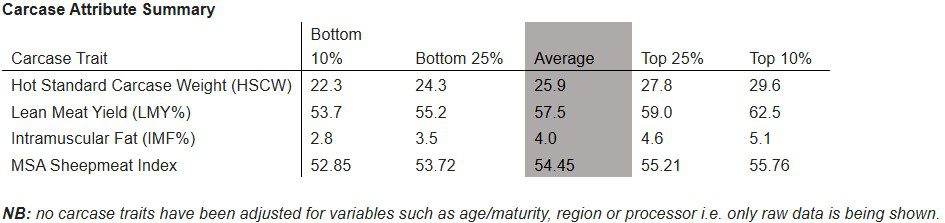
The MSA Sheepmeat Index is a weighted average of the eating quality (for the most common cooking type) of all cuts from the carcase. It represents the overall eating quality of the carcase and is a single number producers can use to benchmark performance.
The MSA sheep model established an index average of 54.45. Any entrants to the carcase showcase scoring more than 55.76 would be classified as being within the top 10pc, according to MLA’s Meat Standards Australia program manager Dave Packer.
All entrants would be receiving a flock profile “to benchmark how they are performing,” he said. All lambs have been genomically tested and the data will be fed into a validated eating-quality sheep breeding values.
Meat & Livestock Australia’s MSA program manager David Packer said that the model will be shared across the industry.
“It’s what we’re commercialising right now,” he said.
IMF has a positive impact on eating quality, while LMY has slight negative impact. Both emerged as the major determinants and both are influenced by genetics and nutrition.
The IMF percentage was measured at the eye muscle at the intersection of the rack and the loin and ranged between 1 and 8.9pc with an average of 4.03pc.
LMY is the measure of the lean red meat of the carcase, as opposed to fat or bone and ranged between 44.1pc and 73.3pc, with an average of 57.5pc.
“We need to get higher yields and eating quality at the same rate as they’re both have a primary role in carcase value,” Mr Packer said.
“To give you an example of how yield determines carcase value is a 30kg carcase with, let’s say a 10pc variation on either side of yield.
“On that 30kg carcase across a day’s kill or a week’s kill, that’s 3kg either side,” he said.
“That’s 6kg variation that processor’s seen in what they’re putting in that box at the end of the day, within just a 30kg band.
“So it’s very important for carcase value. That’s why we’re measuring more and more as part of not just lamb, but it’s coming into the beef industry as well.”
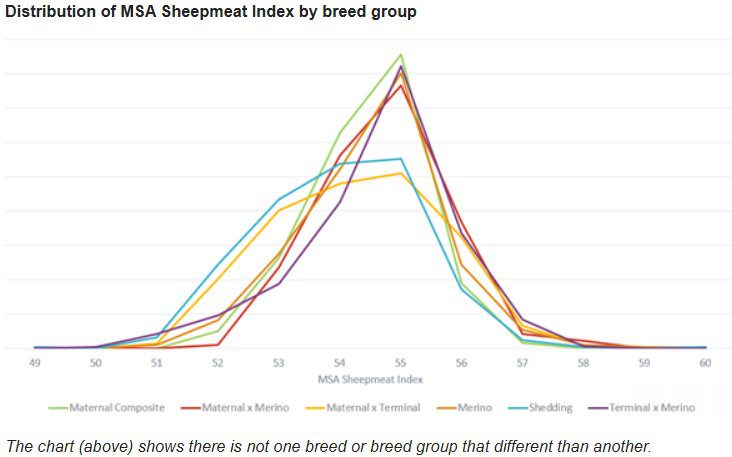
Among the index findings has been that breed has no effect.
“It doesn’t matter what breed; you’ll always get good and bad animals,” he said.
There was also no relationship found between the index and HSCW. Export animals were found to be in the lower levels of eating quality while the lighter domestic animal returned better results – a likely result of genetic expression, Mr Packer said.
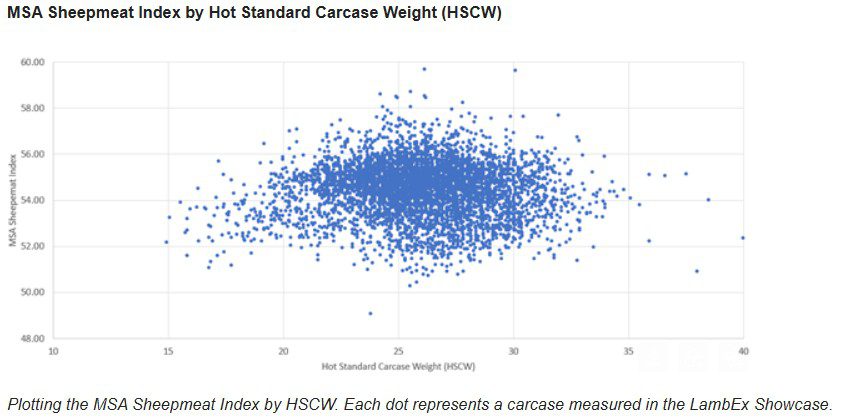
There is no relationship between the MSA Sheepmeat Index and HSCW, meaning that regardless of weight at slaughter, there was a variation in eating quality. This means some animals can express genetics for eating quality regardless of weight at slaughter.
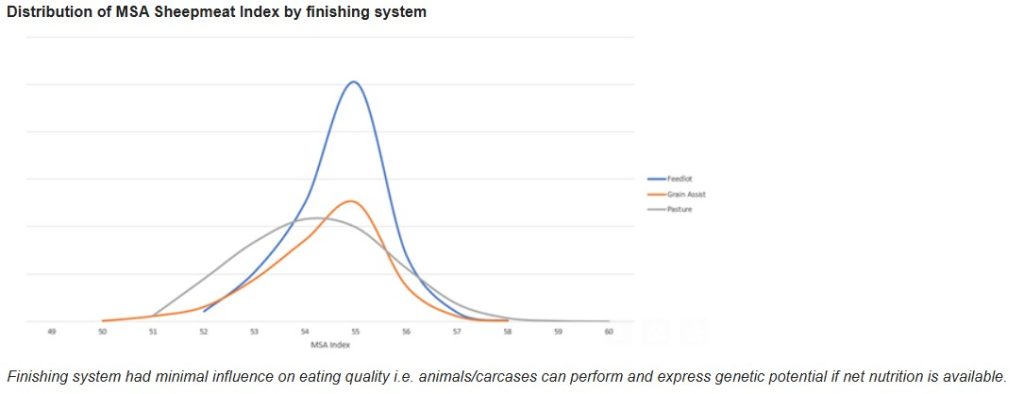
Finishing systems also had no effect, he added, although ‘you get consistency out of feed lots and you get sustainability of supply’.
Mr Packer said: “We can’t always chase IMF. Yes, it’s important but we need to think about other traits in breeding and management.”
Genetics matched with the right nutrition were the key, he said, making ram selection important – as was balancing genetic traits for the best outcome.
“Do your research before you go to those ram sales. Don’t get caught up in price fights for the biggest and prettiest ram, although it might be structurally sound,” he said, advising buyers to use consultants and other resources “to support your decisions, because everything you’re buying in now is going to have influence for 10-plus years in your flocks.”
HAVE YOUR SAY