
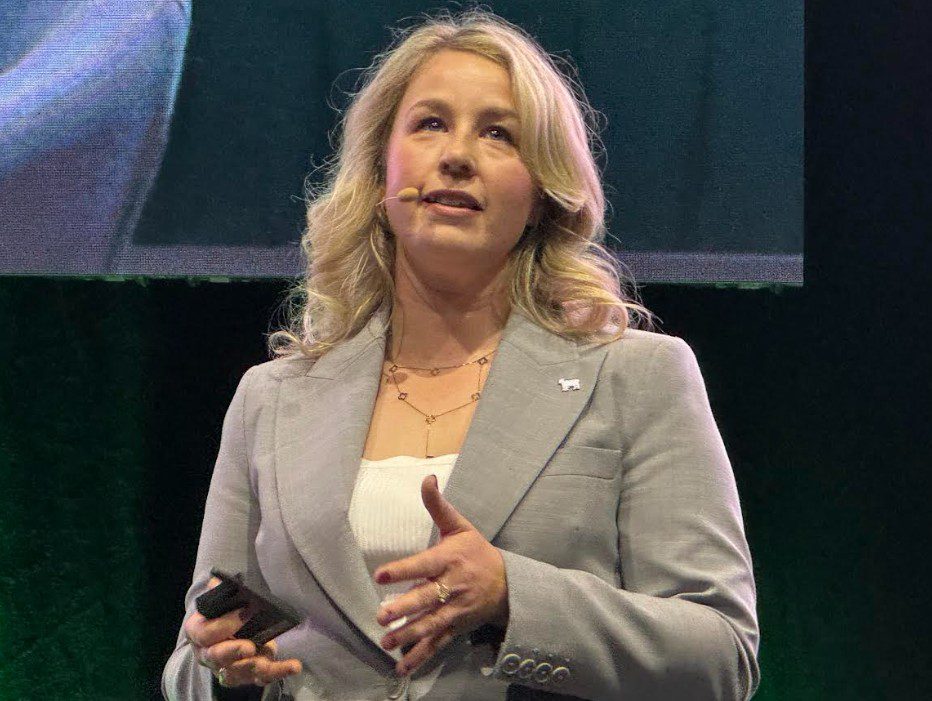
SPA CEO Bonnie Skinner in Adelaide today.
AUSTRALIAN sheep producers will have to wait at least another 6-12 months before they see a Future Flock Strategy after a formerly mooted launch at Lambex 2026 did not happen today.
Sheep Producers Australia’s Frequently Asked Questions section on the Future Flock website today still said that the strategy would be launched at LambEx26 (7-10 July 2026) in Adelaide, South Australia.
Sheep Central believes this was because the original grant agreement with the Federal Government stipulated an end date of grant activity or agreement of 30 June 2026.
However, an article on the FFS website dated 21 June preempted Ms Skinner’s presentation stating that while LambEx is an important milestone, and a key event to showcase our progress to-date, it is not the finish line.
“The Future Flock is intended to be a living strategy; by design, it will continue to evolve as industry priorities, markets and opportunities, and global conditions change,” the article said.
“Unlike many strategic plans and initiatives of the past, The Future Flock consultation was never intended to end with the completion of a report.”
At the Adelaide Convention Centre today, SPA chief executive officer Bonnie Skinner instead gave a synopsis of the Future Flock Strategy consultation process with a printed report detailing the industry’s status on profitability, land use and demographics, challenges and opportunities.
Ms Skinner said the consultation process to date has included around 300 people attending the 10 invitation-only regional workshops supported by state farming organisations, 24 national interviews and 97 national surveys.
After her presentation, when asked if she considered the document released was a strategy, she said SPA had been working to get the input from about 300 people over the past six months.
When questioned whether 300 people was enough to represent the industry, Ms Skinner said she would love to be talking to as many people as possible as part of the consultation, although she conceded the regional workshops were invitation only.
“Because we had a limitation on how many people we could accommodate within those workshops.
We’ve jhad open consultation with surveys and other opportunities for input and we’ve been seeing those come in from across the whole consultation,” she said.
“I want to hear from as many people as possible.”
“It has never been a closed off opportunity for people to get involved with the Future Flock and it is only going to be possible if we do get the input from as many people as possible,” Ms Skinner said.
“So we’ve been sharing the opportunities for people to create surveys, we held webinars recently, I think there is a lot more for us to do to engage people.”
When asked if her presentation was the FFS launch, Ms Skinner said SPA had feedback from people that they did not want to an outcome rushed for the sake of a deadline.
“So we tried to listen to that – I think it’s really important that with the consultation that we did – which was pretty extensive ion a short period of time, that we actually have the opportunity to take what we’ve heard back out to industry and get their feedback on that, and listen to that feedback.”
Click here to read the FFS report.
SPA to fund next consultation phase
Ms Skinner said SPA will fund the next phase of the strategy’s development.
“So we’ve got a lot of work to do to take out findings that we’ve gathered out of this first phase of consultation.”
Ms Skinner did not say if all the consultations findings were in the document released at Lambex. But said SPA needed to test the findings with industry and get their feedback.
“Then we need to understand of those things coming up through the consultation, what are the things that we need to prioritise and eventually that’s going to have to develop into an implementation approach.”
When asked if SPA had wool industry support for FFS, Ms Skinner said the strategy is spanning both the sheep and the wool industry.
“I have seen a lot of wool industry participants come and be involved in this process.”
She said a number of wool industry groups had participated in the strategy process and offered to produce a list of supportive groups.
Ms Skinner said her presentation was to communicate what the consultation had heard so far and the state farming organisations had already seen it in a webinar and will get the chance to review the draft strategy.
“This is not the end of the road here, no one is being cut out of the process.”
Livestock SA leader bemoaned lack of review opportunity
However, in the Livestock SA July newsletter distributed last week, Livestock SA president Gillian Fennel said state farming organisations, the bodies that directly represent producers at local and regional levels, will not be given the opportunity to review and provide formal feedback on the strategy before it is presented at LambEx.
“This is not good enough. We are the organisations closest to producers on the ground. Our members’ priorities, their lived experience of markets, seasons, regulation and supply chain pressures, should be informing this strategy before it is presented publicly – not after.”
Ms Skinner told Sheep Central Future Flock would be a vision for the whole sheep industry for the next 10 years.
“I would expect that we are going to make a substantial lot of progress on an ongoing basis in the next six months.”
Ms Skinner did not deny that SPA had sought an extension to the FFS grant contract, but conceded that the funding coincided with the end of the financial year.
“I think 6-12 months is the horizon that we’ve got to keep developing this out on.
“It’s not just the strategy, it’s the implementation approach as well,” she said.
“I don’t know if we will have started implementing things, but I would hope within that timeframe that we’ve got a lot of agreed implementation activities that have got the buy in and the agreement of people from across the industry – that’s the next phase.
“I think the time is to do this properly and develop the strategy and if that takes 12 months, I would to see it happen sooner, but it is going to take as it needs to take within that time period.”
WoolProducers outlines Future Flock position
After Ms Skinner’s Future Flock presentation at LambEx, WopolProducers Australia chief executive officer Jo Hall released a statement outlining the peak grower body’s decision not to support the strategy process under the initial launch timeline.
Ms Hall said WoolProducers Australia’s decision not to participate in the Future Flock Strategy (FFS) was based on clear governance, process and strategic concerns that were communicated to both Sheep Producers Australia and the Department of Agriculture, Fisheries and Forestry in discussions that took place between October and November 2025.
“As outlined in our correspondence following our November 2025 board meeting, we advised SPA and DAFF that our producer representative board resolved that WoolProducers would not hold an official role in the project due to a lack of information, insufficient clarity regarding the strategy’s purpose, and concerns that key issues raised by our organisation had not been adequately acknowledged or addressed.
“Our concerns centred on several key issues,” Ms Hall said.
“First, we believed the process associated with the initial project proposal, tendering process and project inception lacked transparency and genuine industry ownership.
“We questioned how a project intended to develop a national vision for both the sheep meat and wool industries could proceed without meaningful engagement with the peak body representing woolgrowers,” she said.
“We consistently argued that a strategy of this scale required broader consultation and a clearer understanding of its intended objectives before development commenced.
“This information was not forthcoming,” Ms Hall said.
“Second, we raised concerns about governance and accountability.
“The project carried significant execution risk, yet there was insufficient clarity regarding deliverables, stakeholder responsibilities and measures of success.
“WoolProducers also had to consider the potential resource and financial burden that this placed on our organisation, given there were two full time staff with workplans set on strategic priorities of the wool industry, plus the lack of financial compensation for our involvement.
Ms Hall said as a representative organisation, WoolProducers had an obligation to assess whether participation would expose our organisation to reputational, governance and financial risks.
“Based on the inadequate information available, we determined those risks were too high.
“Third, and most importantly, we repeatedly warned that the proposed timeline was unrealistic,” she said.
“We argued that a comprehensive national strategy designed to guide both the wool and sheep meat sectors could not be properly developed, consulted on and delivered within the timeframe proposed by SPA and DAFF.
“WoolProducers even implored SPA to go back to government and extend the delivery timeframe, whereby we were told it was not possible to do so,” Ms Hall said.
“We made it clear that the requirement to launch the strategy at LambEx 2026 set a timeline in which it was never going to be possible to develop and deliver a meaningful and robust industry strategy.
“WoolProducers would not support a process that risked delivering a substandard outcome simply to meet an arbitrary deadline.”
Ms hall said subsequent events have validated those concerns.
“The original stated intent was that the FFS would be completed and launched at LambEx in July 2026.
‘Instead, project proponents have since acknowledged that the development of the strategy will continue beyond LambEx and is now being framed as a “living document” that will evolve over time.”
Ms Hall said while adaptive strategies have merit, this represents a significant departure from the original proposition presented to WoolProducers and industry, and the one that WoolProducers based its decision on.
“The evolution of the FFS into a ‘living document’ demonstrates precisely the concern WoolProducers raised from the outset; that the project scope and ambition could not realistically be delivered within the original timeframe.
“The slippage in delivery, including both scope and time, confirms our initial assessment that the proposed schedule was overly ambitious and that a more considered development process was required.”
Ms Hall said the delayed Future Flock delivery milestone, scope creep and concerns about the authenticity of consultation and development reinforce the governance concerns that informed our decision.
“Had WoolProducers formally committed to the project, we would have assumed responsibility for a process, including potential ongoing financial obligations, where the risks were apparent to us from the beginning and where constructive concerns raised in good faith had been repeatedly dismissed.
“For these reasons, WoolProducers remains confident that its decision not to participate was the correct one,” she said.
“It was a prudent governance decision, made to protect the interests of our organisation, and subsequent developments have only reinforced that assessment.
“Far from being proven wrong, the concerns we raised to SPA and DAFF late last year regarding transparency, process, governance and timing have been borne out by the project’s own evolution and failure to deliver the strategy in the manner originally proposed.”
Ms Hall said WoolProducers supports the concept of a unified long-term strategy for Australia’s sheep and wool industries.
“Indeed, we still believe there is an opportunity to build genuine alignment between the meat and wool sectors to create a shared vision for the future.
“However, that opportunity requires transparency, proper consultation, realistic timeframes and broad industry confidence,” she said.
“It cannot be stated that the wool industry has engaged in the process in anything other than an ad hoc manner, given neither the peak representative body for wool growers, WoolProducers nor the peak wool industry supply chain body, Wool Industries Australia, have formally taken a role in the development of the FFS.”
“Looking forward, WoolProducers would like to reiterate that we are always willing to work with all industry and government stakeholders, to deliver genuine industry good outcomes for the sheep and wool industries and look forward to continuing to do so.”
I always thought Yes Minister was just a British comedy, but now we have our own Australian version – its called Sheep Producers Australia.
The level of ridiculousness at SPA is staggering – and they expect to be taken seriously by the sheep industry. SPA has a complete lack of integrity and needs to be disbanded for completely mis-using industry funds.
The sheep industry will continue to be substandard to other agriculture while we have this incredibly poor representation.
After reading the actual document released at LambEx, a few things stand out that producers should weigh up before this gets called a “strategy”:
It isn’t a strategy, it’s a summary.
There are no priorities ranked, no targets, no timelines, no budget and no owners. The “what happens next” section commits only to testing findings and designing actions later. That’s a prospectus for a strategy, not the thing itself.
The consultation base is thin: 300 people through invitation-only workshops, 24 interviews and 97 surveys, from a national industry of tens of thousands of businesses. By comparison, the live export phase-out panel (one segment, one state) took 800+ submissions and 3300 survey responses. “Remarkable consistency emerged” is asserted, but no numbers, no breakdown of who was in the room, and not a single dissenting view is reported.
The 300 figure needs a closer look.
Those regional workshops were invitation-only, and the invitations largely came through the state farming organisations. The problem is that most sheep producers aren’t SFO members. So the core of the consultation was drawn from a self-selected, already-engaged minority, which is exactly the group least likely to reflect the views of the wider producer base whose confidence the report claims to be measuring. That’s a real sampling bias, not a nitpick.
The peak wool body isn’t on board.
WoolProducers Australia declined to participate over governance, transparency and timeline concerns raised back in Oct-Nov 2025. A document claiming to be a “shared vision” for both sheep meat and wool can’t credibly say so when the peak wool grower body and Wool Industries Australia never took a formal role.
State farming organisations weren’t given a formal review before it was presented publicly, per Livestock SA. The bodies closest to producers were shown it, not asked to shape it.
The elephant in the room is missing entirely.
No mention of the live sheep export phase-out, despite workshops in Katanning and Northam, and despite it being the single biggest driver of the flock contraction, WA destocking and “wavering confidence” the report spends pages describing. Also absent: mulesing/social licence, climate, biosecurity/FMD, and China wool-market concentration. You can’t diagnose confidence while refusing to name what’s shaking it.
The data quietly argues against the optimism.
The report’s own charts show sheep as the worst-performing enterprise for productivity growth over 40 years (0.5 percent vs 1.6pc for cropping) and farm cash incomes persistently below cropping. A neutral read of those figures is that flock contraction is rational reallocation, a case the report never engages with.
Presentation errors don’t inspire confidence.
The hero pull-quote misspells “achieved,” the footnotes skip from 1 to 3 to 9 (several missing), Figure 6 labels “Other Pulses” twice, there’s no Figure 1, and the headline GVA figure contradicts itself ($11.4bn “full supply chain” vs a table showing $11.4bn direct / $14bn indirect).
The concept, a genuine shared vision across meat and wool, is worth backing. But this needs proper consultation, the wool sector actually at the table, and the courage to name the hard issues. Right now it reads like a document built to a grant deadline rather than to the industry’s needs.