
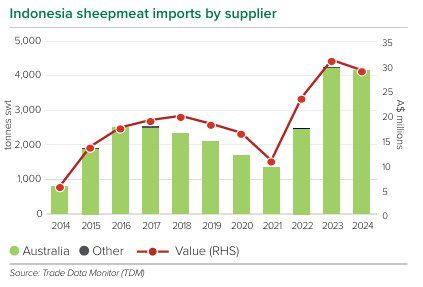
 SHEEP meat processors maintain it is the Australian and Indonesian Governments’ responsibility to address import-related restrictions that are limiting northbound shipments.
The Albanese Labor Government last week claimed the approval of five more export beef establishments and a sheep/goat processor for exports to Indonesia would boost further boost access and Minister for Agriculture Forestry and Fisheries Julie Collins said this would mean more high quality Australia halal meat for Indonesian consumers.
However, the Australian Meat Industry Council’s general manager – processing and trade Sam Munsie said the new establishment listings will not result in an increase in high quality Australian halal meat into Indonesia.
“While we welcome the additional listings, AMIC notes that Indonesia’s import permit restrictions on beef and an effective ban on sheep and goat meat imports, means that any new listings will not result in an increase in high-quality Australian halal meat available for Indonesian consumers.
“Australian exporters need predictable, rules-based access to markets like Indonesia, and AMIC calls on the Indonesian and Australian Governments to urgently address the current Indonesian import-permit-related restrictions which are directly impacting and limiting Australia’s red meat trade.”
Sheep Central has been told that following representations against imports by Indonesian domestic producers in 2024, Indonesia has not issued any import permits for sheep or goat meat since the start of 2025, with no WTO-compliant process to justify the ban being in place.
The effective ban affects mutton as well as lamb and goat meat, with trade effectively ceasing from around mid-2025 until present, AMIC said.
However, an Australian processor said meat is getting into Indonesia, but via other countries, rather than through the direct Australia-Indonesia permit system.
Mr Munsie said Indonesia is a critical export market for Australian beef and sheep meat.
“Australia has an export profile that creates value through efficient carcase balance and utilisation, while also providing reliable, safe and secure red meat to Indonesian customers and consumers.”
AMIC said Indonesian beef import permit allocation to commercial importers (non-state-owned enterprises [SOEs]) is only 30,000 tonnes for 2026, down from 180,000 tonnes last year. This compares to 250,000 tonnes of allocations for SOEs, which includes 100,000 tonnes for Indian buffalo meat, 75,000 tonnes for Brazilian beef and 75,000 tonnes for ‘Other’ – which can include Australia as well as the United States and any other country.
End the ‘stop’ on Australian red meat imports
One processor said the Australian Government needed to do more about the Indonesian import permit process and another company with Indonesian access approval, Tasmanian Quality Meats, would also like to see the “stop” on Australian imports.
TQM domestic sales manager Matt Hand said Indonesia is a massive market, but he said the in-country permits are heavily controlled.
“I think there is a big push by the Australian Government to get that Indonesian sheep meat path open again.
“It’s a big market that is closed now.”
A Department of Agriculture, Fisheries and Forestry spokesperson said the Australian Government has and continues to make representations to the Indonesian Government wherever possible on the importance of timely and reliable issuance of import permits now and for future years, consistent with the Indonesia-Australia Comprehensive Economic Partnership Agreement (IA-CEPA).
The Australian Government advocacy has included representations at the Ministerial level and through DAFF and Department of Foreign Affairs and Trade officers in Australia and in Jakarta. Australia has also raised its concerns about timely and reliable import permit issuance at the WTO in Geneva, Sheep Central was told.
Most mutton and lamb consumed in Indonesia is produced locally
Meat & Livestock Australia’s regional manager, South East Asia, Valeska, said Indonesia presents strong long‑term potential for Australian beef, sheep meat and goat meat.
“Demand for halal protein continues to grow alongside population growth, rising incomes and an expanding middle class, and Australian product is well regarded for its quality, consistency and halal integrity.
“This new market access is significant because it expands the range of Australian suppliers able to service Indonesia and gives importers greater confidence of supply,” she said.
“While sheep meat and goat meat are smaller categories than beef today, these approvals create a solid platform for future growth and diversification, particularly as Indonesian consumers seek more premium and trusted protein options.
“For Australian producers and processors, it’s an important step forward in building volume, value and resilience in this market,” Valeska said.
“The majority of lamb and mutton in Indonesia is locally produced, estimated to be around 100,000 tonnes per year based on Indonesia Ministry of Agriculture data, and imported products currently only account for a very small component (only around 1 percent is imported), filling the gap in the premium segment where customers are looking for cut variety and consistency.
“With the growing appreciation for lamb, we have been working with Indonesian partners – including local producers who are using Australian genetics in their breeding herd – to grow the overall consumption of sheep meat and goat meat,” she said.
HAVE YOUR SAY