
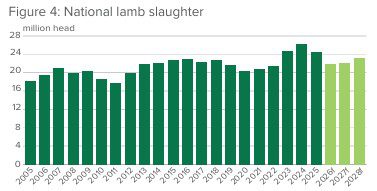
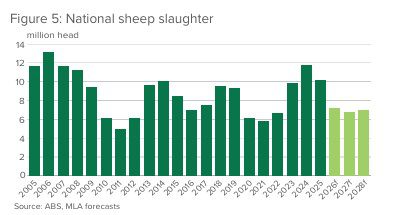
 LAMB and mutton slaughter is expected fall further this year, according to Meat & Livestock Australia’s latest sheep industry projections.
MLA said today lamb slaughter is forecast to decline 11 percent in 2026 to 21.86 million head, following an estimated 6.9pc fall in 2025, as the effects of several years of heavy turnoff continue to flow through the system.
Mutton slaughter is expected to contract more sharply, falling 30pc to 7.13 million head, reflecting the tighter supply dynamic.
MLA said the nation’s sheep industry is entering a lower supply phase in 2026, with the projections indicating an estimated decline in the national sheep flock of 2.7pc to 67.1 million head by 30 June 2026.
This reflected the cumulative impact of below average rainfall across key southern production regions including Victoria, South Australia, Tasmania and southern New South Wales, MLA said. While some late summer rainfall has provided short-term relief, soil moisture and pasture conditions remain under pressure in many areas.
 MLA senior market information analyst Emiliano Diaz said three consecutive years of difficult seasonal conditions have weighed heavily on the flock.
“Producers have been managing through sustained seasonal pressure, and the high levels of turnoff over recent years have reduced flock size and constrained the potential for a rebuild if the seasonal outlook improves,” Mr Diaz said.
Productivity gains and heavier carcase
MLA said despite lower slaughter volumes, productivity gains and heavier carcase weights are continuing to support output. Average lamb carcase weights are forecast to lift to 24.6kg, supported by ongoing genetic improvement, grain feeding and processor demand for heavier stock.
As a result, lamb production is expected to decline 10pc in 2026 to around 537,000 tonnes carcase weight, which would still rank among the stronger production years on record.
Mr Diaz said the figures highlight how productivity gains are underpinning supply even as numbers tighten.
“While lamb turnoff is forecast to be lower in 2026, improvements in genetics, feeding systems and carcase weights mean production remains relatively resilient by historical standards,” Mr Diaz said.
Mutton production is forecast to fall 29pc as the effects of earlier heavy ewe and wether turnoff further reduced supply.
Exports and global demand
MLA said tighter supply is expected to limit exportable volumes, although reduced global availability continues to support underlying demand, particularly as New Zealand’s flock remains constrained.
 “Global sheep meat supply remains tight and Australian product continues to be well regarded across key export markets.
“However, higher livestock prices, freight costs and currency movements are expected to influence competitiveness and trade flows through the year,” Mr Diaz said.
MLA said live sheep exports also face ongoing uncertainty. Volumes declined in 2025 due to lower supply, vessel availability and high domestic prices, and trade conditions remain influenced by shipping disruptions and geopolitical instability in the Middle East.
Despite this, demand for Australian sheep persists across the region, reflecting Australia’s strong animal health and quality reputation.
Prices to remain high
MLA said price forecasts point to relatively stable conditions across sheep indicators through 2026, with prices remaining well above long-term averages despite some mixed movements.
The National Heavy Lamb Indicator is forecast to lift 1pc, the Trade Lamb Indicator to rise 0.5pc, while the Restocker Lamb Indicator is forecast to ease 4pc by 30 June 2026.
“Lower flock numbers and reduced turnoff are expected to support prices, but conditions remain finely balanced.
“The pace of any potential flock rebuild in the future will depend heavily on seasonal improvement and producer confidence,” Mr Diaz said.
While slaughter and production are expected to stabilise over the medium term, MLA expects 2026 to be a year of adjustment rather than expansion for the sheep industry, as producers manage through constrained supply, ongoing cost pressures and variable seasonal conditions, MLA said.
To find out more, MLA’s Market Information Team will run through the key findings of the report and answer questions during the Cattle and Sheep Industry Projections 2026 Webinar.
Register here: Cattle and Sheep Projections Webinar – Tuesday, 31 March at 11:30am (AEDT)
To view the full report, visit: Sheep Industry Projections 2026
HAVE YOUR SAY