
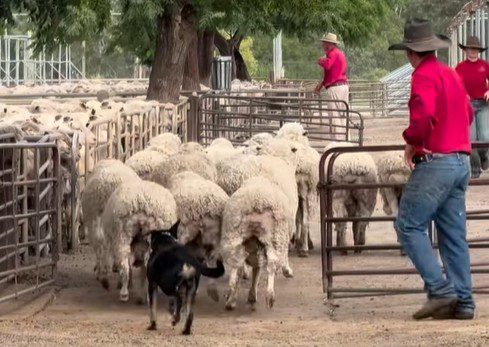
Lambs are moved through the Dubbo saleyards. Image – Facebook. Dubbo Regional Livestock Markets.
THE American-Israeli bombing of Iran affected lamb prices at the Bendigo saleyards in Victoria today, but recent rain, lower industry supplies and strong restocker demand are expected to mitigate any ongoing impacts.
National Livestock Reporting Service market reporter Jenny Kelly said prices for lambs under 20kg carcase weight “ran into the trouble of the war in the Middle East and suspended air freight for MK (Middle East Kill) processing lambs.”
Ms Kelly said high rainfall totals reduced the Bendigo sale offering to 9190 lambs and 3350 sheep. Heavy export lamb prices were “either side of firm to a top of $365/head”, with not all processors operating. Medium and heavy trade lamb prices were firm to $10/head stronger in isolated places for very neat domestic lambs, but with overall sale averages remaining below 1100c/kg on the main processing categories, she said.
“Once under 20kg cwt the market ran into the trouble of the war in the Middle East and suspended air freight for MK processing lambs.
“Lighter weight lambs were $5 to $20/head cheaper with only a couple of processors capable of holding lambs still operating,” Ms Kelly said.
“There was some new store buying activity, but agents did note that most people would wait for roads and paddocks to dry out a bit and the real impact from this rain could still be ahead.
“Depending on breed light lambs to processors were starting with $9 and $10kg cwt price tags rather than the $11 and $12kg the market had been recording,” she said.
The NLSR last week said the Restocker Lamb Indicator lifted 11.5 cents to 1124.5c/kg carcase weight (cwt). Premiums were achieved at the large eastern states markets in Wagga (1261c/kg cwt) and Ballarat (1,224c/kg cwt) for restocker lambs, which made up 17.3 percent and 11.2pc of the total yarding for the category.
However, Peter Milling and Co managing director Graham Anderson at Dubbo said the Middle East conflict had not impacted lamb prices at the city’s saleyards today, with rainfall limiting supplies from western New South Wales while lifting restocker demand from the Broken Hill area.
“I think the market is dearer,” he said during the sale.
Elders livestock manager Martin Simmons agreed and said the light and restocker lambs sold dearer, up about $10-$15, especially for restocking lambs. Light processing lambs fwere $10 dearer on the back of the restocking interest.
“They had to keep their noses in front on those lighter lambs to be able to fill their requirements.”
The market was very very strong, he said, with the best lambs topping at $477 for local lambs averaging 94kg lwt, and the mutton market was “unbelievably strong”, with up to $115 for the lightest sheep.
He said an order booking restocking lambs back to the Broken Hill area drove the light lamb market.
“He put a genuine floor in it and livened it right up.”
Fuel, oil and currency impacts of greater concern
Midfield Group general manager Dean McKenna said he was aware the conflict had suspended airfreight and shipping into the Middle East.
“We’ve been very very cautious in what we do.
“But I don’t see that the conflict would affect light lamb prices, because it is store buyers who have set the pace, not the processors.”
He expected rainfall across the country in the last 24 hours would also put some confidence in the market.
Mr McKenna said the disruption to shipping and airfreight is of serious concern, but processors had gone through similar restraints during COVID.
“I believe we know how to handle it.
“Of more concern is what it will do to oil prices, fuel costs and the Aussie dollar, that’s of greater concern.”
One Western Australian lamb exporter said the conflict might mean increased shipping costs if future shipments are forced to take a long route. Iran has reportedly closed shipping lanes through the key Strait of Hormuz trade route after the attacks on the country.
Airfreight and shipping closures creating complexities
Australian Meat Industry chief executive officer Tim Ryan said AMIC notes recent geopolitical developments in the Middle East and their implications for the safety of people in the region and on global trade flows.
“The broader geopolitical tensions are serious and likely to have profound effects regionally and globally.
“We are aware that the closure of key shipping lanes and airspace in the region is creating complexities for Australian meat exporters with product in-transit,” he said.
“The dynamic and uncertain situation suggests that this will continue for the immediate future and will likely have flow-on effects to global logistics.
“The Australian meat industry has a track record of adapting amid challenging conditions and it plays an important role in underpinning food security in many countries, including those in the Middle East,” Mr Ryan said.
“Australian meat exporters are managing the situation to the best of their ability.
“AMIC will closely monitor developments in the Middle East and work with members, government and industry to assess any emerging risks or impacts.”
The Australian Livestock Exporters’ Council said it is continuing to monitor the unfolding situation in the Middle East.
“We are working closely with our exporter members and the Department of Agriculture, Fisheries and Forestry to consider any potential impacts; however it is too early to tell what these impacts may be given the evolving nature of the situation,” ALEC said in a statement.
“The safety of members of our industry and animal welfare remain our highest priority.
“Our thoughts are with our colleagues in the Middle East.”
HAVE YOUR SAY