
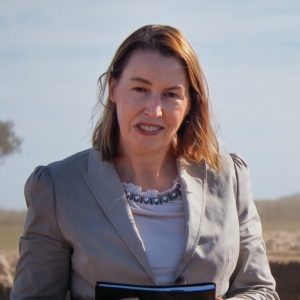
Robbie Sefton
AUSTRALIA was missing wool marketing opportunities while it continued mulesing sheep, respected communications specialist Robbie Sefton told the National Saleyards Conference in Wagga Wagga last week.
Answering a question about whether advocacy for a practice could limit change, using mulesing as an example, Ms Sefton said she and her husband had only recently sold their 11,000 sheep as part of enterprise changes, but she was a supporter of not mulesing.
“We bred that out of our sheep and hadn’t mulesed for 20 years.”
Ms Sefton said the industry needed strong leadership and needed to be clear about who its customer is.
“Its customer is a global customer that wears wool, like I’m wearing today and they will not tolerate that behaviour (mulesing).
“So that’s where industry needs to be strong and they need to be saying, as in wool growers who sit on the decision-making boards — whether it is WoolProducers, Australian Wool Innovation – they need to understand the markets they are operating in.”
Ms Sefton said agriculture and the wool industry is being sent very clear messages around things like mulesing.
 “Mulesing is a very uncomfortable experience to have, for the person let alone the sheep – those days are gone and we as an industry need to get that,” she said.
“So whether you personally disagree with it, you’ve got to get over that and move to what the indicators are from the markets.
“Australia has the reputation of producing the best food and fibre in the world and things like that really do get in the way,” she said.
“Is there any wonder that the wool industry is in the state that it is in now?
“So I will speak strongly about that, I think we are missing opportunities.”
Ms Sefton said Australia was just lucky that wool made extraordinary fibre with many marketing options.
How saleyards can keep social licence
Ms Sefton said the consequences of losing social licence in agriculture have been seen in the community backlash against live export of sheep.
“And for those of you from WA I have a lot of sympathy and empathy for you.”
She said she and her husband Alistair Yencken had a farm in Kojonup in WA and had bred and grown wethers for the live sheep trade, and he had worked on export vessels into Saudia Arabia.
“So I really understand the challenges that we had there and again this united voice is very important.”
She said there had also been social licence debates around glyphosate and land clearing.
“And we are seeing right now around water reform, carbon markets and animal welfare scrutiny.
It is being seen in the Netherlands, with farmers protesting against nitrogen limits that threaten their livelihoods, and in the United Kingdom where rewilding policies are reshaping farming systems and subsidies, she said.
“Here in Australia, conversations around methane, biodiversity and indigenous engagement are already changing how we farm.
“And if we don’t proactively shape these narratives they’ll be shaped for us, often by people who don’t understand the full picture, often focused and shaped by activists,” she said.
Get proactive not defensive
Ms Sefton said one of the biggest challenges faced by agriculture is that the sector often went into defense mode on social licence issues.
“We can get very defensive in agriculture and I can assure you in today’s society that does not serve us well.
“We feel misunderstood, targeted and unfairly judged and sometimes we are,” she said.
“But the answer isn’t to shout louder.
“The answer is to listen better and explain more clearly,” Ms Sefton said.
“The most effective PR isn’t spin, it’s about storytelling around a truth.
“it’s about sharing not just what we do, but why we do it, who does it, how they do it; the values behind the practice, the science behind the decisions, the people behind the outcomes,” she said.
“Being proactive, not proactive; good PRD is proactive.
“It means building relationships before a crisis, not scrambling to fix reputational damage after it happens.”
Saleyards need to tell their story
Ms Sefton said saleyards are commercially and culturally essential to the livestock industry, but are often misunderstood.
“That’s why we need to be telling our story.
“We need to talk about the economic benefits, the community role and the animal welfare standards, the innovation happening and the traceability and technology,” she said.
“The fact that our livestock goes to market in great trucks with great drivers and in good timeliness as we talked about and heard about with the Meat Standards Australia story earlier today.
“That story isn’t just for those already understanding agriculture, it’s for those who don’t.”
Although she said agriculture’s viewpoint is being better communicated than in the past, Ms Sefton said so often those in agriculture talk “into our selves” more often than to people outside the sector, “because their perceptions shape our future, whether through policy, regulation or market demand.”
Ms Sefton said people can smell inauthenticity, while authenticity, consistency and trust is built on “showing up, telling the truth, owning our mistakes and demonstrating our willingness to improve.”
Citing the lack of knowledge among politicians at a recent water policy meeting in New South Wales, Ms Sefton said “it’s how we communicate and how we tell our story that makes the difference.”
She said her experiences have taught her that people don’t expect farmers to have all the answers.
“But they do expect us to care, to listen and to act in good faith.”
Ms Sefton said rural people need to use their platforms wisely and consistently.
“You’ve probably heard it all before, the city just doesn’t understand the bush.
“That gap between rural and urban Australia is real and it’s growing.
And in a world where we have fewer people that have direct connections to farming and to our livestock and agricultural sectors, the risks are becoming more and more difficult, and at times we are becoming targets,” she said.
A single source of truth to maintain trust through truth
Ms Sefton’s communication tips for saleyards included having a single source of truth, good media relations and using other industry bodies to get the sector’s message out.
“A single source of truth isn’t just best practice, it’s a lifeline.
“It ensures every person sees and hears the same timely information, cutting through confusion, stopping rumours at the door,” Ms Sefton said.
“By unifying messages through a central trusted space we can show and tell our stories on our terms, in our words, with our images.
“So I really recommend with your saleyards to be really clear what you stand for, to make sure your staff know that and to communicate that.”
She said it was important for saleyards to maintain good relationships with the media, have a “go to” media spokesperson who has had media training and turn staff into ambassadors. She said using social media is also important.
“If somebody gets the story wrong, correct it quickly, respectfully and calmly.
“Don’t get angry or defensive, make sure you’re accurate,” she said.
“When something goes wrong in a crisis, it’s time to be honest and good PR is really important.”
She said in the case of disease outbreaks, a video taken out of context or animal welfare concerns, the public wants leadership not silence.
“Good communication, good PR helps you get ahead of the story, shows accountability in action and it helps rebuild trust.
“You really need to have Q and As prepared; you need to be prepared for an issue as it may happen.”
Ms Sefton said trust is hard to regain once lost, but the returns from earned trust are huge, including a better community relationship, stronger buyer and seller confidence, more community, political and industry support, and less vulnerability to activist pressure.
“So you’re not just moving livestock, you’re moving a regional economy and you’re creating jobs.
“You’re connecting farmers to markets and you’re feeding families,” she said.
As long as 85 percent of Australian wool ends up in China, mulesing will continue. If Australia wants to be more palatable for European or American markets, then mulesing is a no-go. I understand genetics do work. Long live Aussie growers.
Well said.
Hello, do you have an alternative to mulesing?
The pain killers encourage profiteering by chemical companies and are open to food safety speculation. The plastic clips would be harmful to the environment as there is no way to collect the plastic that falls off. It is also a slow ache compared to the searing burn, but better in that there is no open wound.
You have talked about trust, but that will only come with viable solutions as the government has slowly taken away the ability to be flexible. The different areas also require different wool types. Is there a solution for this? If you want to bring back a meat industry that is losing a battle to the wages that make a balance for people to live, I hope you are able to find a balanced solution.
Please ask MLA to extend lamb into hogget as a better meat from wool types. The meat type sheep’s wool is coarse and heavy, that cannot be sold to the wool markets that are complaining about mulesing. This is the way farmers are turning away from this particular industry. Fashion is the expensive end and a too narrow market. With the longevity of wool materials a wool coat can last a lifetime, meaning you will not be able to sell it to the consumable fashion market.
I hope you achieve your end goal, as I feel the market for food is very unbalanced.
One last question, does the government look into the welfare of the animals slaughtered over in America before allowing these products into Australia?
But she is very happy to have her wool produced by sweat shops. If mulesing goes so does at least 30 percent of Merinos.
I am not from the land, so to speak, but this speech is akin to the Julia Gillard speech in impact, I believe.
Positive inspirational and reflecting real-world wide sentiments. Timely as well.
The wool industry is one to protect. We all thought it would go on forever. The wool fibre is unmatched for warmth and Merino is highest quality. Oil-based synthetic fibres are faster to spin into yarn and0 consistent, but lack quality. Vegetation, dags and small skin pieces contaminate wool
The oil-to-yarn system can be switched on and off at will, sheep are dependent on farmers 24 hours a day; in dry weather when feed is short, with heavy rain the fences are washed out, sheep scattered and with warm weather flies lay maggots wherever there is moisture .. urine and faeces.
Muelsing removes the ewe’s wool near urine and faeces for the lifetime of the sheep.
If Robbie owns sheep, not growing wool where urine and faces encourage maggots, then those 11000 sheep, may well be the base breeding stock for Australian genetics. Australian farmers have wanted to grow sheep safe from flystrike forever. Nobody likes mulesing, but like circumcision, it keeps them clean.
Great article and spot on.
We have to get much smarter and greatly improve our marketing skills. We promised the world non-mulesed wool by 2010, yet 80 percent of our wool is from mulesed sheep.
South Africa’s wool is 100pc from non-mulesed sheep.
I found a similar situation with lamb in the UK and the Netherlands, Aussie lamb not sighted, but Fern brand ex-NZ everywhere. A family of mine — butchers and restaurateurs — refuse point blank to use Aussie lamb and use only NZ or Scottish lamb.
Their comments were – Australia has yet to learn to listen to customers, act on serious concern, actually identify customers needs and exceed their needs.
That we are still using chemicals here in agriculture that have been banned in western Europe for years is of concern too.
Australians need to get their act together; time is running out and customers will drive the sleepers here to change.
Valuable observations. Mulesing has been illegal in NZ since 2018 though I have not seen or heard of the practice here.
Not appreciating the value, skills and effort of others work is common unfortunately.
Robin Sefton should be lauded for her understanding of the industries woes and in showing the pathway forward.
Robbie sounds like she’s good mates with Jacinda.
Leave farmers alone and have a bit of respect for the people who live in adverse conditions for less than their city counterparts. You really need to be careful or you’ll start to experience way more demand for dwindling supplies of food and fibre. You spruik about corporate farming and don’t realise that family farming wins hands down in tougher times as corporate shareholders won’t tolerate lower profits, whereas family farms will survive working for less until the tide turns.
I’m surprised that you are listening to these minority vegans and interfering dogooders who will eventually ruin survival for everyone. They too need agriculture to survive even though they deny that. So pull your head in and enjoy your retirement as it’s obvious that you are a statistic in this wonderful industry. I along with three generations before me have run Merino sheep and after successfully continually cutting 10 kg of 21 micron wool year in and year out have had a guts full of bullying and bullshit from people like you. So my sons and myself have given sheep and wool the flick along with most other sheep and wool producers which reiterates my point. You and your mates can starve and freeze. Yours realistically, Denis Byrne
Denis Byrne. May I encourage you to go back and reread what you have written? I understand you are very angry, and I acknowledge everyone has the right to express an opinion, but just reflect on the impact you are having on our valued customers around the world. It is a very serios matter, we all need to listen more carefully to our customers and do our best to satisfy their requirements.
Great article. It has been questioned if it is legal for growers to pay the wool levy. I understand some don’t and it hasn’t been challenged. Growers are not getting value for the profit end of their efforts by paying the cream, or should I say “skim” to AWI. All staff, including directors, require a KPI. The directors’ KPI is that they increase the wool price indicator above CPI at a minimum. They have all failed as a board in guiding the industry. They are required to explain, as there has been no satisfactory explanation. They need to be all dismissed. Where is the Minister for Agriculture, Fisheries and Forestry on this? You are very welcome to come and talk to growers.
Tell the activists to grow up and keep voting how they do. Food doesn’t grow on their whims, wishes or wants.
Robbie is an articulate and an extremely intelligent lady. She always was and always will be.
Really Robbie. The proactive message has been done to death. The reality facing agriculture is the media thirst for sensational news and opinions which are often based on misinformation and straight-out lies. When this rubbish is refuted or corrected to the media the train has moved on and the argument finds a bin.
You say mulesing is out. Could you please explain how you bred your sheep so you didn’t have to? We haven’t been in the industry for almost a decade now. But back then we did mules, never lost sheep from doing that, but I can assure you that the sheep being fly-blown is very cruel and quite deadly at times. So I would love to know how you prevent this today.
Wendy
The work has been done to breed sheep that don’t need mulesing and are fly-resistant. Using the genetic solution, sheep can bred to be fly-proof and not need to be mulesed in two sheep generations. Unfortunately AWI has completely ignored the great work by others and as a result the problems have remained.
I remind wool growers that AWI collects a levy to preside over the wool industry.
What a wonderful range of thoughts and advice from an extremely knowledgeable lady. I only hope the industry participants think long and hard about the industry’s future and who is consuming our products. It’s the grower’s responsibility to consider the consumer the husbandry of the animals they produce.
Please clarify … this article is written by an ex-sheep farmer?