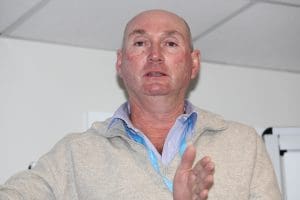
Cye Travers – a massive opportunity to link saleyard quality assurance with LPA.
SALEYARDS Australia will work toward a national industry body-linked quality assurance system after a discussion at the sector’s national conference last week.
Former SA board member and saleyard operator Cye Travers said Saleyards Australia will continue to work with Meat & Livestock Australia and Integrity Systems Co on a national quality assurance program in line with Livestock Production Assurance.
About 30 percent of Australia’s livestock saleyards are accredited under NSQA Ltd’s National Saleyard Quality Assurance program, but it is a stand-alone system not aligned with any other industry quality assurance programs.
Mr Travers said a new saleyard quality assurance program aligned with LPA would require completion by saleyards of many of the modules it required of livestock producers.
“A new system by being part of LPA would be very much aligned with current industry standards.
“It would have the same auditing requirements and frequency and may have additional modules to cover some saleyard-specific issues,” he said.
At the Saleyards Australia conference in Wagga Wagga last week, Mr Travers said the discussion was not about any perceived shortcomings of blessings of NSQA.
“It’s about how we move forward – is that NSQA or another version of NSQA, or is it something different.”
Mr Travers said the SA board had developed a mission statement in the belief the industry needed to embrace quality assurance. Reasons for that included the middle position of saleyards in the supply chain between producers and processors, he said.
 “On the producer side, now post the development of NSQA, we have an amazing system called LPA…
“On the other side of us sits either an AUS-MEAT export licence and quality assurance program or a state food safety-based program depending on what state you are in…,” he said.
“We sit in the middle, most of us not being in NSQA, with no quality assurance program on site, apart from some internal systems that we may have developed and so we become the weak link in the supply chain, if you like.”
“I don’t believe saleyards can afford to be, for the future of saleyards, the weak link in that supply chain any longer and I think the board probably feels that as well, without speaking for them.”
Mr Travers said MLA managing director Mike Crowley told him MLA had just done a risk or GAP assessment on the supply chain and industry had identified saleyards as a “potentially large risk to the supply chain without quality assurance in place that is aligned to the rest of industry’s quality assurance and quality standards” and what needs to be delivered to customers around food safety, quality and environment.
Mr Travers said he had received offers of financial and in-kind support “to bring us on a quality assurance journey beyond the small section of our industry that’s currently covered by NSQA.”
He asked whether that meant expanding and modernizing NSQA or involve the saleyard sector becoming part of LPA under ISC.
“I think there is a massive industry for saleyards if we can be industry-aligned and our vendors and our users can assess that (LPA and feedback) data by still selling through saleyards.”
“By being part of LPA and having that reach through our vendors will hopefully have the ability to have that reach through and pull the data back, which takes some of them around saleyards at the moment.”
Opportunity and funding with LPA link
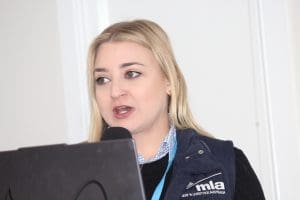
ISC quality policy and compliance manager Elizabeth Bradley.
ISC quality policy and compliance manager Elizabeth Bradley presented on how the LPA on-farm quality assurance program worked for producers, including incorporation of National Livestock Identification System traceability by linking with the Property Identification Code. She said if a property is not LPA accredited its animals could be “held up” through a saleyard and the program underpinned food quality and safety standards, and access to many markets. Just under 175,000 producers are LPA accredited, she said, and the program is audited to ensure producers are doing what they declare on the National Vendor Declaration for sale stock. LPA also has biosecurity and animal welfare standard modules, Ms Bradley said.
“The modular way we have LPA is an opportunity…. we can add more into LPA to provide more assurance for different things.”
She said ISC was constantly looking at ways to expand the LPA program to meet market requirements.
She said Cye’s suggestion of “saleyards fitting nicely into the family is a pretty good opportunity.”
NSQA executive officer Mark McDonald said the NSQA program has been running for 25 years “on a shoestring”, but hasn’t had the necessary financial resources. It had about 38 members.
“I think the NSQA board is quite open minded about what options are out there and as I said yesterday, the core stuff that people are using now is likely to be whatever goes forward in whatever format.
“So for the people that are using it (NSQA) it might not be that much of a change potentially.”
NSQA and SA board member Paul Christopher said any saleyard that is in NSQA “please keep using it until there is something else.”
“I mean you are better off doing something than nothing that we know so if you stop using any system it’s at your peril really if something happens.”
Mr Travers said the biggest risk to the saleyard sector on quality assurance “is not doing anything at all.”
Saleyards Australia president Paul Martin received a “quite resounding” show of hands from conference delegates in support of Saleyards Australia setting up a working group to progress discussions.
HAVE YOUR SAY