
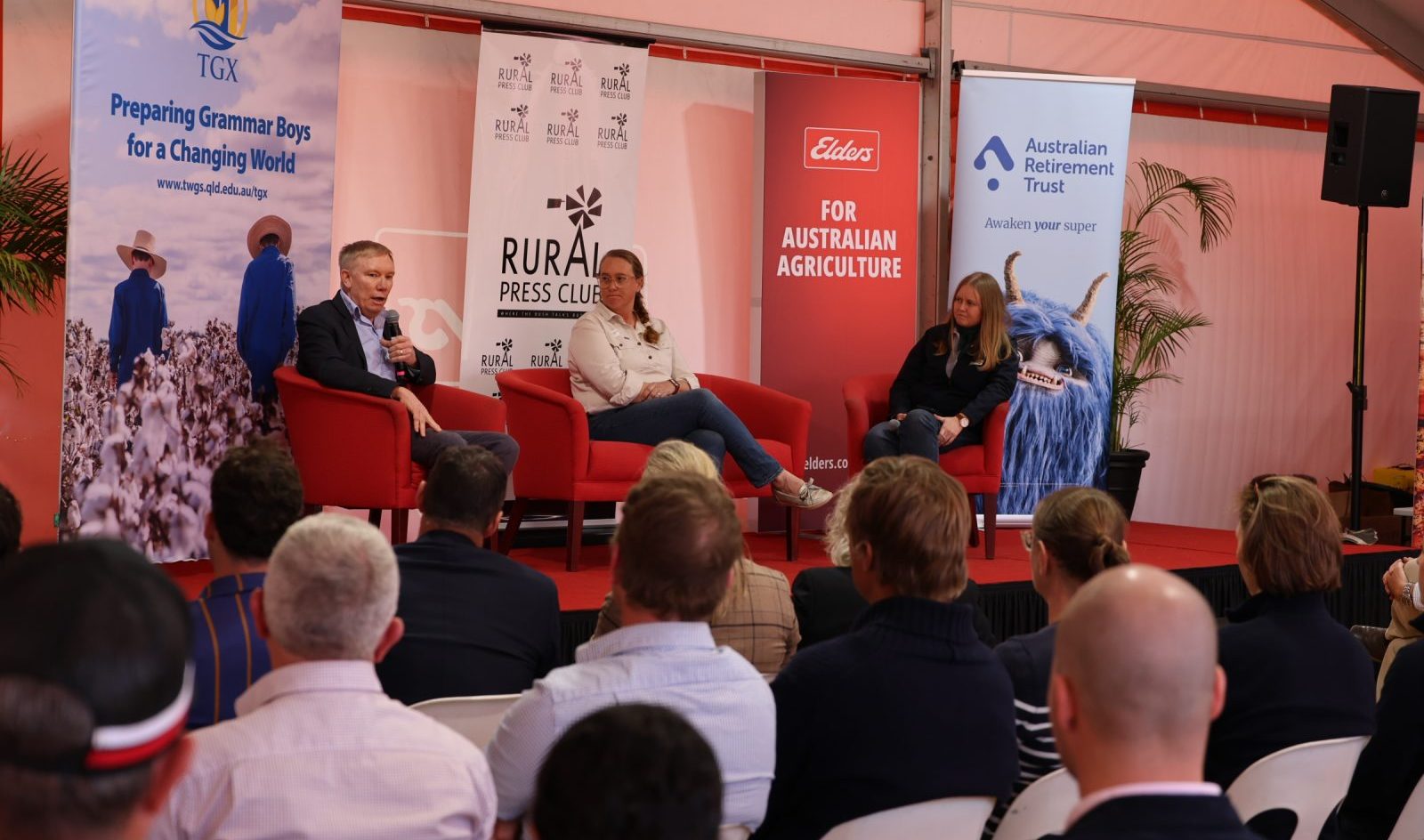
DataFarming’s Tim Neale, Agworld’s Meg Kummerow and moderator Lucy Kinbacher.
ARTIFICIAL intelligence has the potential to reshape farming as we know it, and the change is one to be embraced as growers face mounting cost pressures.
Helped by satellite-driven data capabilities thanks to Elon Musk’s Starlink, and Jeff Bezos’ incoming Amazon Leo network, the use of AI is now possible across Australia as the connectivity hurdle is cleared.
It means AI can potentially be used to guide grower decisions and circumvent issues caused by a lack of platform interfaces as we begin to entertain the idea of farming without paddocks, and travel in personal aerial vehicles.
The points were made last Wednesday as part of the Rural Press Club of Queensland’s first ever FarmFest event, which saw DataFarming managing director Tim Neale and Agworld customer success representative Meg Kummerow take to the stage to share their thoughts and field questions.
Help from space
The discussion was hosted by RPC committee member and Queensland Country Life editor Lucy Kinbacher, and based on the topic: “With challenges mounting across agriculture, what cutting-edge technology is helping Australian farmers stay productive, resilient and competitive?”
With connectivity always a hot topic in the bush, Ms Kinbacher asked how Australian agriculture could step into the digital world when some “struggle to send a text or email in the main street” of their town.
“I think unfortunately those problems have been solved by someone outside of Australia, and with [Jeff] Bezos launching all his constellations now, there’s going to be huge competition for Elon, which is great,” Mr Neale said.
“It’ll bring a lot of competition to the market.”
While lamenting the fact that the Australian Government has not solved the issue, DataFarming, with its heavy reliance on satellite imagery, is grateful for the progress.
“It did take about 10 years longer than I thought, but the connectivity issue is well and truly on the way to being solved.”
Likewise, Ms Kummerow said satellite technology is allowing agriculture to overcome the issue of the farmer but not the hectares being connected.
As a pioneer in the introduction of drones to Australian agriculture, Ms Kummerow said connectivity has been her “biggest battle as a business owner” since before 2010, and only recently has stable internet connection been possible.
“Starlink came in and that was absolutely game-changing,” Ms Kummerow said.
“I would not be able to do what I do if it weren’t for Starlink,” she said, adding that the Jeff Bezos equivalent would bring welcome competition.
Here comes AI
Data centres around the world, including in Toowoomba, are competing for land, power and water, and powering AI, which is presenting workarounds to a range of problems for agriculture.
“What it’s doing is doubling your capacity as a human being in your daily work,” Mr Neale said of its impact on agronomists.
However, he does hold some concerns around data security.
“The biggest fear I’ve got right at the moment is this AI hacking, and that’s the biggest unknown.
“If that gets loose, everyone’s in trouble, not just agriculture; the lights won’t come on.”
He is positive about AI’s ability to increase the efficiency of the farmer and the consultant.
“It’s going to give us a huge amount of extra capacity, so don’t be fearful of it; we’ve got to embrace and run with it.
Ms Kummerow assured the primary producers and advisors in attendance at the lunch, held in the Elders tent at FarmFest, that AI would not putg them out of a job.
“I don’t think there will ever be a replacement for farmers,” Ms Kummerow.
“I did hear a story of a farmer…inputting all of their recommendations from a previous season into an AI bot with a view to replace their agronomist.
“I haven’t heard the outcome yet, so it couldn’t have been good.
“They always say you’re the best fertiliser for the country – farmers’ boots on the ground – and I align that to an agronomist as well.”
Efficiency push
The US-Iran conflict which closed the Strait of Hormuz in March is the most recent cause of price and supply chain shock, and in this environment, both panelists said growers were looking to agtech to improve their bottom line.
Mr Neale said cropping margins have become were very tight, and even the best corporate growers have recently been making as little as 4 per cent (gross margin) as agriculture copes with a “rapidly changing world and rapidly changing input supplies and prices”.
Using platforms like DataFarming, he said growers may be looking to AI and agtech to counter a particular problem like acidity, or to find out how best to spend their $100,000 for fertiliser as they seek greater efficiency and improved profits.
“They can make hundreds and hundreds of dollars a hectare gains from that sort of technology.
“There’s many factors that drive adoption, and economics is one of those.”
Ms Kummerow said AI and the use of digital platforms enabled targeted use, which could give the grower insights into use what was available for maximum effect by asking: “Where am I best placed to put fertiliser instead of just going blanket everywhere?
“How can I best use the limited supply that I have?”
Mr Neale said more use will improve the AI modelling.
“A lot of software that we build uses a lot of smarts behind the scenes, so if we can get better implementation, more algorithms for smarter outcomes for growers, then that’s what we should be using AI for, to speed up the process.”
In seasonal and supply windows, AI could well come into its own to scope results from even just Australian research.
“Imagine it’s read every single GRDC article; there’s no human that has read every single GRDC article.
“Get it to do that work for you and say: ‘I’m in this limited supply environment; what’s the best way of managing that on my farm with the tools that I’ve got?’
“I think that’s what we need to be doing.”
Ms Kummerow said some years ago, when she was in the drone industry, she assessed all the different regulations across Australia for drone applications.
“It took me weeks to read through all the legislation, and I just did another version and did it through AI.”
Airborne movement
Ms Kummerow was the first person to sell a DJI drone in Australia back in 2017, and believes drones can still play an important role in agriculture.
“I align a drone more to a tractor than anything else you need,” Ms Kummerow said.
“A drone is just a platform that you can attach something to for an outcome.”
With satellite imagery now down to a resolution of 1cm2, she said satellites will “more and more” replace the image-gathering functions of drones.
“I think there’s roles for both things, and the drone spray thing obviously has really taken off.”
Ms Kummerow said autonomous fixed-wing aircraft were already at work in South America, and were an example of the progress being made in agricultural aviation.
In 10 years’ time, Mr Neale can see himself leaving the ground in his own quest for efficiency.
“I think…what’s going to transform Australian agriculture is unmanned personal drones, that fly you to where you need to go autonomously.
“China is building thousands of them right now, and it will transform rural Australia because the problem we’ve got in rural Australia right now is a tyranny of distance.
“I’ll be the second person to buy a personal drone so I don’t crash.”
No more ‘silos’
Mr Neale said agriculture had “disparate siloed data sets”, and original equipment manufacturers and others may see those silo walls broken down.
“AI will pull that together and give you the answer you want today, and that’s the power, I think, of AI…it’s about answering the question you want answered on the spot.”
“That’s the one thing we’re really good at is making siloed data sets; we’ve got hundreds of them.
“The software that you use today on your computer will look nothing like that in the very near future.
“You won’t even have software per se.”
“We are still failing at an OEM level for designing decent bloody software.”.
He referenced his recent visit to the cab of a state-of-the-art boom spray which would not accept a file.
“It was the most complicated, complex, brand new piece of equipment I’ve ever been in, and [with] the most enormous amount of features and multiple screens and it just wouldn’t do the…simplest of jobs.
“If you’re an agronomist in the room, I bet you…haven’t got your client’s yield data on your phone.”
“We’re 25 years into yield mapping now, and an agronomist still doesn’t access easily… your [yield] maps.”
“We’ve entered the world of AI development and holy smokes, like it’s just blowing our socks off what’s achievable.”
Ms Kummerow agreed.
“AI, I think, is only going to make the ability to integrate between platforms just so much easier,” she said.
Think like a robot
With SwarmFarm units as an example, Mr Neale expressed his idea that robots could see farms and farming systems from a new perspective.
“A robot is making you think… do I really need paddocks anymore?
“Why are we still farming with paddocks?
“Can anyone tell me?
“Why are we treating blocks of land the same when, in fact, there’s about five different soil types in every paddock,” Mr Neale said, touching on his bugbear of yield variation as being an enemy of productivity.
“We’re trapped in an ancient thinking.”
Inspire early
Toowoomba Grammar School, with its TGX program, was the sponsor of last week’s Rural Press Club of Queensland event, and Mr Neale referenced the importance of it and similar programs to inspire young students.
“That’s the kind of thing that needs to be built, some infrastructure that actually puts a focus on agtech,” Mr Neale said.
Ms Kummerow was studying at Dalby Agricultural College in 1999, and remembers the course taking here and her peers to the Maillers’ property at Goondiwindi to see autosteer in action as a revolutionary piece of technology that inspired her.
She said this tangible kind of experience was invaluable in attracting young people to agriculture in a pathway that complemented academic and skills-based learning.
“I think part of it is we don’t have the ag college system anymore.
“Universities are great, but they’re not for everybody.
“I think now schools are taking over the space that ag colleges once did,” Ms Kummerow said, also acknowledging the TGX initiative among schools looking to inspire careers in agriculture and related fields.
“I think part of it is showing them the technology.
“We can do that through schools but you’ve got to get them early.”
Mr Neale said the shrinking of farming communities, an aging population, and a mining sector “that was like a giant vacuum cleaner of talent” have been some of the issues faced by the agricultural sector this century.
However, bright spots exist.
“I think there was a real big shift where we now see that maybe the 30 to 40 year olds [are] very strong in the communities now.
“There was a renewed excitement about agriculture.
“Technology was coming, and I think that drove a lot of people back.
Ms Kummerow said the driver of innovation and technology was the younger generation.
“The first thing they do is look at their phone and want to do what they need to do on their app, on an app and their phone, so I think that has also been a driver of the younger generations.”
HAVE YOUR SAY